Capitalism and the Common Human
A Visual Investigation — Edition One / 2026
How an economic system shapes what we produce, consume, desire, believe — and become.
EVIDENCE · MECHANISM · CONSEQUENCE
A VISUAL INVESTIGATION — EDITION ONE / 2026
PRODUCE · DESIRE · CONSUME · WORK · YOU ARE HERE
Capitalism and the Common Human
How an economic system shapes what we produce, consume, desire, believe — and become.
EVIDENCE · MECHANISM · CONSEQUENCE · 37 PAGES
C O N T E N T S & M E T H O D
What follows is an investigation, not a verdict.
I The Machine 03 V Identity for Sale 23 What capitalism is. What it rewards. Status, brands, fandom — and why Why it produces what it produces. people defend billionaires.
II The Factory of Desire 09 VI The Loop 26
   Advertising, commodification, and the                 Work, wages, debt, and the markets we
   engineering of wants.                                 cannot opt out of.
III The Culture Industry 14 VII Power 30 Adorno and Horkheimer, Concentration of wealth, and its standardisation, documented routes into politics. pseudo‑individualisation. VIII The Balance Sheet 33 IV The Attention Economy 19 What the system gets right, what it How a feed became a factory, and the cannot do, and the open questions. viewer became the product.
RULE 1 — EVIDENCE RULE 2 — SEPARATION RULE 3 — SYMMETRY
Every number carries its Three different things are Every serious criticism here year, its geography and its kept apart: measured is met with the strongest source. Where credible evidence, contested counter‑argument its sources disagree, the interpretation, and opponents actually make. disagreement is shown philosophical argument. Not for balance. For
rather than resolved. Mixing them is how accuracy. analysis becomes propaganda.
A note on what this is not A note on the word itself
This is not a case for capitalism, and not a case against it. “Capitalism” is used loosely to mean at least six different Both of those documents already exist in enormous systems. Singapore, Sweden, the United States and India quantity, and neither is useful for the thing most people all qualify, and they behave nothing alike. Page 8
actually want: to understand the machinery they live separates them. Until then, read “capitalism” as inside. shorthand for one thing only: an economy in which productive assets are privately owned and coordinated The claim here is narrower and stranger. It is that an by markets, where the surplus flows to owners, and economic system does not only allocate goods. It also where the pressure to reinvest that surplus never shapes, through ordinary and traceable incentives, what stops. gets made, what gets promoted, what gets wanted, and
eventually what kind of person it is convenient to be. Everything else in this document follows from that last clause.
CAPITALISM AND THE COMMON HUMAN 02
PART I — THE MACHINE
What does capitalism actually do?
Start with an ordinary morning. You wake to an alarm on a phone you replaced eighteen months ago, though the old one still worked. You scroll a
feed whose contents you did not choose. You go to work you would not do for
free, to earn money you will mostly spend on things advertised to you by the
companies that own the feed. None of this is a conspiracy. All of it is a system
working as designed.
The textbook definition of capitalism is three THE CLAIM IN ONE PARAGRAPH words long: private ownership, markets, profit. It Capitalism answers the question “what can beis accurate and almost useless — in the way that produced and sold at a profit?” extraordinarily describing a person as “carbon, water and well. It has no mechanism for answering calcium” is accurate and almost useless. “what should be produced?” — and none at all for asking whether the wants it satisfies were A more honest definition treats capitalism as a wants it created. These are not flaws in machine for generating incentives. Nobody execution. They are the boundaries of what the needs to be greedy, cynical or coordinated for it instrument can measure.
to run. It runs on one structural fact: a firm that
does not grow is eventually replaced by one that
does. Every other behaviour follows. 16× From that single pressure comes a cascade RISE IN AVERAGE INCOME PER PERSON, 1800–2025 reaching far outside economics. If growth is From roughly €900 to nearly €14,000 a year in constant compulsory, demand must be continuously 2025 euros, while population grew eightfold. No prior found or manufactured. If demand must be economic arrangement produced anything close. Any manufactured, persuasion becomes an industry. honest critique begins here.
If persuasion becomes an industry, it needs World Inequality Report 2026, Ch.1, Fig 1.1. Global; 2025 euros. access to human attention. If attention is scarce,
it becomes valuable. If it is valuable, it will be
measured, traded, optimised and eventually 53% / 8% farmed. SHARE OF GLOBAL INCOME: TOP 10% VS BOTTOM 50%, 2025 At the end of that chain sits a person who cannot 556 million adults receive 53% of world income; 2.8 explain why they open the same app forty times billion receive 8%. Any honest defence begins here. a day. World Inequality Report 2026, Ch.1, Fig 1.3. Global; 2025.
“The question is not whether the machine works. It plainly works. The question is what it optimises for — and whether that is the same thing as a life going well.”
DIAGRAM 1
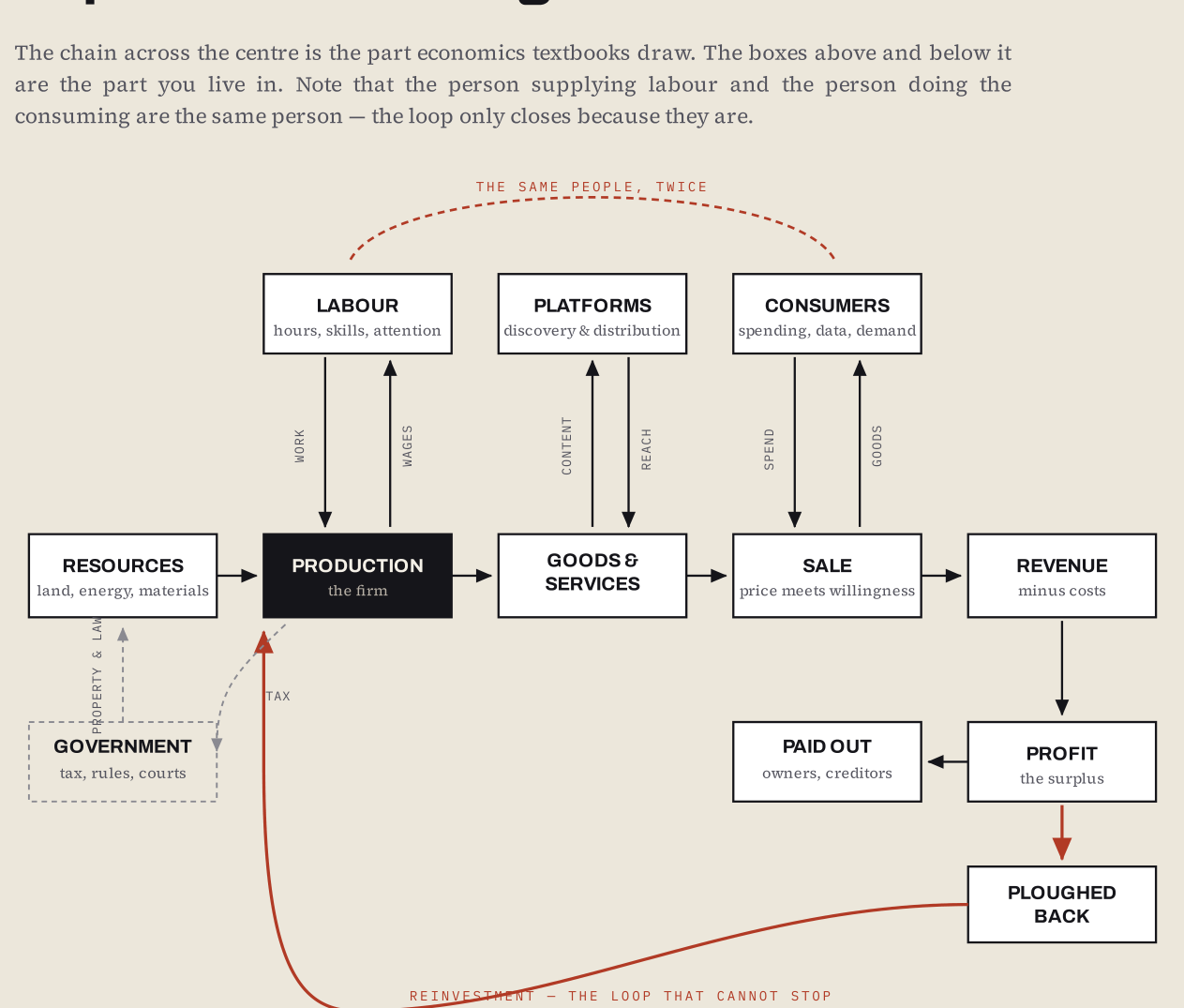
Capitalism in one diagram
The chain across the centre is the part economics textbooks draw. The boxes above and below it
are the part you live in. Note that the person supplying labour and the person doing the consuming are the same person — the loop only closes because they are.
                                                      T H E  S A M E  P E O P L E ,  T W I C E


                  LABOUR          PLATFORMS        CONSUMERS

                            hours, skills, attention        discovery & distribution       spending, data, demand


                                                               WORK                            WAGES                                                                                                                                                                                                                                                                    GOODS                                                                                                                                                                                                                                       CONTENT                   REACH                                SPEND


RESOURCES        PRODUCTION        GOODS &             SALE            REVENUE
                                        SERVICES   land, energy, materials               the firm                                                                                                price meets willingness           minus costs

         LAW

&


                           TAX                                    PROPERTY
GOVERNMENT PAID OUT PROFIT tax, rules, courts owners, creditors the surplus
                                                                     PLOUGHED
                                                                     BACK


                                             R E I N V E S T M E N T  —  T H E  L O O P  T H A T  C A N N O T  S T O P
Read the red line first The loop needs a bigger mouth Where governments sit
Everything else here is a transaction Because the loop must widen each The dashed box is not outside the between willing parties. The red line turn, the SALE box has to absorb system. Property rights, contract is the one thing nobody chose. more every year. There are only enforcement, limited liability,
Reinvestment is not a decision firms three ways: find new customers, get patents and currency are all state make; it is a condition of survival. A existing ones to buy more often, or constructions. There is no firm that pays out everything and get them to pay more. Parts II, III and unregulated market — only markets reinvests nothing is, over enough IV are what happens when the first regulated in different interests. This cycles, outcompeted by one that does option runs out. matters in Part VII.
not.
PART I — THE MACHINE
Profit is not a motive. It is a filter.
The most common mistake in arguing REWARDED PENALISED about capitalism is treating profit as Things that can be Things that are free or shared something people want. It is more useful to owned treat it as something the system selects for — Things repeatable at Things made once, by hand the way evolution selects for survival scale
without any animal intending to. Things that can be Value that resists measured measurement Consider two identical bakeries. One bakes Things people will pay Things needed by those who bread it is proud of and earns a small margin. for cannot pay The other reformulates for shelf life, adds sugar Things bought again Things that last a lifetimebecause consumers prefer it in blind tests, and
earns a larger margin. The second can afford Costs pushed outside Costs the firm has to carry better equipment, locations, advertising and the firm
lower prices. Within a decade there is one
bakery. THE STRONGEST COUNTER‑ARGUMENT
Nobody was corrupt. Nobody conspired. A The filter does something remarkable: it kills filter was applied, repeatedly, and the bad ideas fast, at no cost to the public. Under central planning, a wrong decision about how surviving product is the one that passed it. many shoes to make persists for years Now apply that filter to films, news, schools, because no signal contradicts it. In a market it hospitals, apps, medicines and cities, and you appears as unsold inventory within a season. have the modern economy. This was Hayek’s enduring point, never convincingly refuted: prices carry dispersedThe filter rewards neither “good” nor “bad”, but knowledge no committee could assemble. The a narrow set of properties — which is why the filter is crude but fast, and speed of error- world it produces has a recognisable texture. correction compounds over decades.
LOOK CLOSER — THE LAST ROW THE REPLY The sixth row is the quiet one. A cost landing Granted. But notice what the signal is made of. on someone outside the transaction — polluted A price aggregates willingness and ability to air, an exhausted worker, a distracted pay. It cannot distinguish a billionaire’s mild teenager — appears on no ledger. Economists preference from a poor family’s desperate call these externalities: a price registers only need, because the second never enters the data what someone was billed for. as a bid.
Nearly every argument here about culture, The market is an excellent instrument attention and identity is, at bottom, an measuring a slightly different quantity from argument about externalities that were never the one we care about. The gap between priced. demand and need is the next page.
PART I — THE MACHINE
Why markets don’t simply produce what people need
A market does not respond to need. It responds to need backed by money. Those 831m two overlap often enough that we forget PEOPLE IN EXTREME POVERTY, 2025
they differ — then are baffled when the Living on under $3 a day (2021 PPP), down from about 2.3 billion in 1990 — the largest reduction in material economy produces abundance and scarcity deprivation ever recorded. at once. World Bank Poverty & Inequality Platform, 2025 nowcast. Global. There is no shortage of luxury handbags. There
is a shortage of affordable housing. Both come from the same system, operating correctly. The 3.7bn handbag buyer has money; the person who PEOPLE BELOW $8.30 A DAY, 2025 needs a flat at a rent they can pay is, as far as The line typical of upper‑middle‑income countries. Nearly half of humanity. The same system produced the price signal is concerned, silent. this number and the one above it.
This is not an argument that markets are World Bank, Poverty & Inequality Update, Fall 2025. Global.
immoral. It is an argument about
instrumentation — and trouble begins when A NOTE ON THE WORD “NEED” the reading is mistaken for a full description of “Need” is doing dangerous work in this the room. argument. Who decides what people need? Regimes that claimed to know have produced The four systematic gaps worse outcomes than those that let people decide through purchase. Textbook microeconomics names all four. The dispute is over their size and the remedy, not their existence. So the honest claim is narrower: where willingness to pay diverges sharply from urgency of
-
Public goods. Clean air, basic research, flood need, markets reliably serve the first. A statementdefences, disease surveillance. Nobody can be excluded from the benefit, so nobody can be charged, so the about mechanism, not morality — and market under-supplies — by arithmetic, not malice. testable.
-
Externalities. Costs falling outside the transaction. Carbon is the famous case; the attention costs of an engineered feed, in Part IV, are a newer one.
-
Information asymmetry. Where the seller knows far more than the buyer — medicine, finance, insurance —
competition rewards whoever exploits the gap best, not whoever offers most value.
- Market power. Where a few firms dominate, prices stop being signals and become decisions. Part VII returns to this with data.
PART I — THE MACHINE
There is no such thing as “capitalism”
Most arguments about capitalism are arguments in which two people mean different systems by the same word. Denmark and the DRC are both capitalist; so are Singapore and the United States. The criticisms in this document apply to some varieties far more than others.
VARIETY CORE FEATURE CHARACTERISTIC STRENGTH CHARACTERISTIC PATHOLOGY
Market capitalism Private ownership, competitive Rapid error correction; Ignores anything unpriced. markets, price coordination. decentralised innovation; no Says nothing about central authority needed. distribution.
Social-market Markets plus redistribution, Keeps price signals while High tax burden; depends on capitalism unions and public provision. decoupling health, education political consensus that can Nordic states, Germany. and old age from ability to pay. erode.
Neoliberalism A policy programme, not a Unlocked global trade and Coincides with falling labour system: deregulation, capital flows; contributed to the income share and rising top- privatisation, liberalised fall in world poverty. end concentration. capital, weakened labour.
Consumer Growth sustained mainly by Enormous variety and falling Requires wants to expand capitalism household consumption, real prices for manufactured indefinitely. Produces Parts II supported by marketing and goods. and III of this document. credit.
Monopoly / A few firms control a sector; Scale economies; capacity for Prices become administered, oligopoly capitalism barriers to entry are structural very large, long-horizon not discovered. Political rather than legal. investment. influence grows with market share.
Financial Returns come increasingly from Efficient allocation of capital; Asset-price inflation rewards capitalism asset ownership rather than risk can be spread and priced. owners over earners — a production. mobility problem, not just a fairness one.
Platform Firms own the marketplace, not Near-zero transaction costs; Winner-take-most dynamics; capitalism the goods; value comes from matching at a scale no earlier users become both the network effects and institution achieved. product and the unpaid behavioural data. workforce.
WHY THIS TABLE MATTERS WHERE THE VARIETIES OVERLAP
Almost everything that follows — the culture They are not alternatives on a menu. One industry, the attention economy, the country runs several at once: an Indian commodification of identity — belongs to the household might buy in a competitive local last four rows, not the first. Those describe market, work in a platform economy, borrow institutional arrangements built over forty in a financialised one and vote in a system years, not eternal features of trade. shaped by an oligopolistic media sector — in the same week. That is the difference between a critique and a lament. Institutions can be changed; human Which is why “is capitalism good or bad” is nature cannot. not a well-formed question. Which capitalism, doing what, to whom — that can be answered.
T H E E M P I R I C A L B A S E L I N E Ten numbers this document will unpack
Read them once now. Each is revisited later with its mechanism and its counter‑argument. Nothing here is disputed as a measurement; what is disputed is what it means.
37% 2% 90.2% 33.0% OF ALL GLOBAL WEALTH OF ALL GLOBAL WEALTH US NET PRODUCTIVITY US TYPICAL WORKER PAY HELD BY THE TOP 1% HELD BY THE BOTTOM 50% GROWTH, 1979–2025 GROWTH, SAME PERIOD
WIR 2026 · Global · 2025 WIR 2026 · Global · 2025 EPI · United States EPI · United States
52.4% $1.0– 18h 36m $18.8tn LABOUR’S SHARE OF GLOBAL WEEKLY TIME ON SOCIAL TOTAL US HOUSEHOLD DEBT,INCOME, DOWN FROM 53% IN 1.3tn AND VIDEO FEEDS, TYPICAL Q2 2026 2014 GLOBAL ADVERTISING USER New York Fed · United States ILO · Global · 2024 SPEND, 2026 (FORECASTERS DataReportal/GWI · Global · DISAGREE) 2026
dentsu / WARC · Global45.5% $5.08bn 831m 16× INDIAN HOUSEHOLD DEBT AS US FEDERAL LOBBYING PEOPLE IN EXTREME RISE IN AVERAGE INCOME A SHARE OF GDP, 2026 SPENDING, 2025 — A POVERTY, DOWN FROM 2.3BN PER PERSON SINCE 1800 RBI Financial Stability RECORD IN 1990 WIR 2026 · Global · 2025 Report · India OpenSecrets · United States World Bank · Global · 2025
Two numbers that must be held together What “forecasters disagree” means
The last two entries are not decoration for balance. For 2026 global ad spend, dentsu projects about $1.04tn, They are the reason this investigation is difficult. Any WPP Media about $1.22tn and WARC about $1.30tn — a account of capitalism that cannot explain the fall in spread of roughly 25% on the same underlying market.
extreme poverty is not describing reality. Any account Where this document shows a range, it is because the that cannot explain a top 1% holding 37% of world range is real. wealth is describing a different planet.
THE EMPIRICAL BASELINE 08
PART II — THE FACTORY OF DESIRE
From needs to manufactured wants
In 1930 Keynes predicted we would by now THE MECHANISM IN FOUR STEPS work fifteen hours a week. He was not wrong 1. Find an unresolved feeling. Loneliness, about productivity — output per hour rose inadequacy, ambition, boredom, anxiety faster than he guessed. He was wrong about about ageing or about one’s children. something else: he assumed wants were 2. Make it visible. Show people who appear to finite. have resolved it. Comparison does the persuading; no claim need be made. Keynes divided human needs in two. Absolute needs — food, shelter, warmth — which can be 3. Offer an object as the resolution. Not as a lie — simply as an association repeated until itsatisfied. And relative needs, which exist only by feels native. comparison with other people and therefore
cannot be satisfied, because satisfying them 4. The resolution is temporary. Not by design depends on others having less. in any single case, but because relative needs regenerate the moment everyone else catches He thought the first would dominate. Instead the up.
second did, and an industry grew up to cultivate
it. The fifteen-hour week never arrived because If preferences were fixed and self-the line kept moving. generated, a trillion dollars a year How a want gets made would be the largest misallocation of capital in commercial history.The mechanism is not hypnosis. What advertising
does is subtler: it attaches an existing human
motive — status, belonging, safety, the fear of
being left behind — to a specific purchasable
object. The motive was already there; the object is
new. That coupling, repeated across millions of
impressions, is the industry’s actual product.
THE STRONGEST COUNTER‑ARGUMENT THE REPLY
Advertising is also the cheapest consumer Both hold — for informational advertising. information ever devised. Without it you They hold far less for advertising carrying no would not know a better, cheaper product information at all. A thirty-second film of existed, and incumbents would be shielded attractive people at a beach tells you nothing from challengers. The paternalism in about a fragrance; it competes on association. “manufactured wants” should also be The testable question is the split between the uncomfortable: who is anyone to say which two, and nobody has a clean number — but desires are authentic? People enjoy well-made the industry’s migration towards brand- objects, and that pleasure is not false building rather than product claims is itself consciousness. evidence about which works.
PART II — THE FACTORY OF DESIRE
The price of your attention, paid to someone else
Advertising is the only large industry whose entire output is directed at changing what other people want. Its scale is therefore a reasonable proxy for how much economic effort goes into the production of desire itself.
FIGURE 2.1 — GLOBAL ADVERTISING SPEND, US$
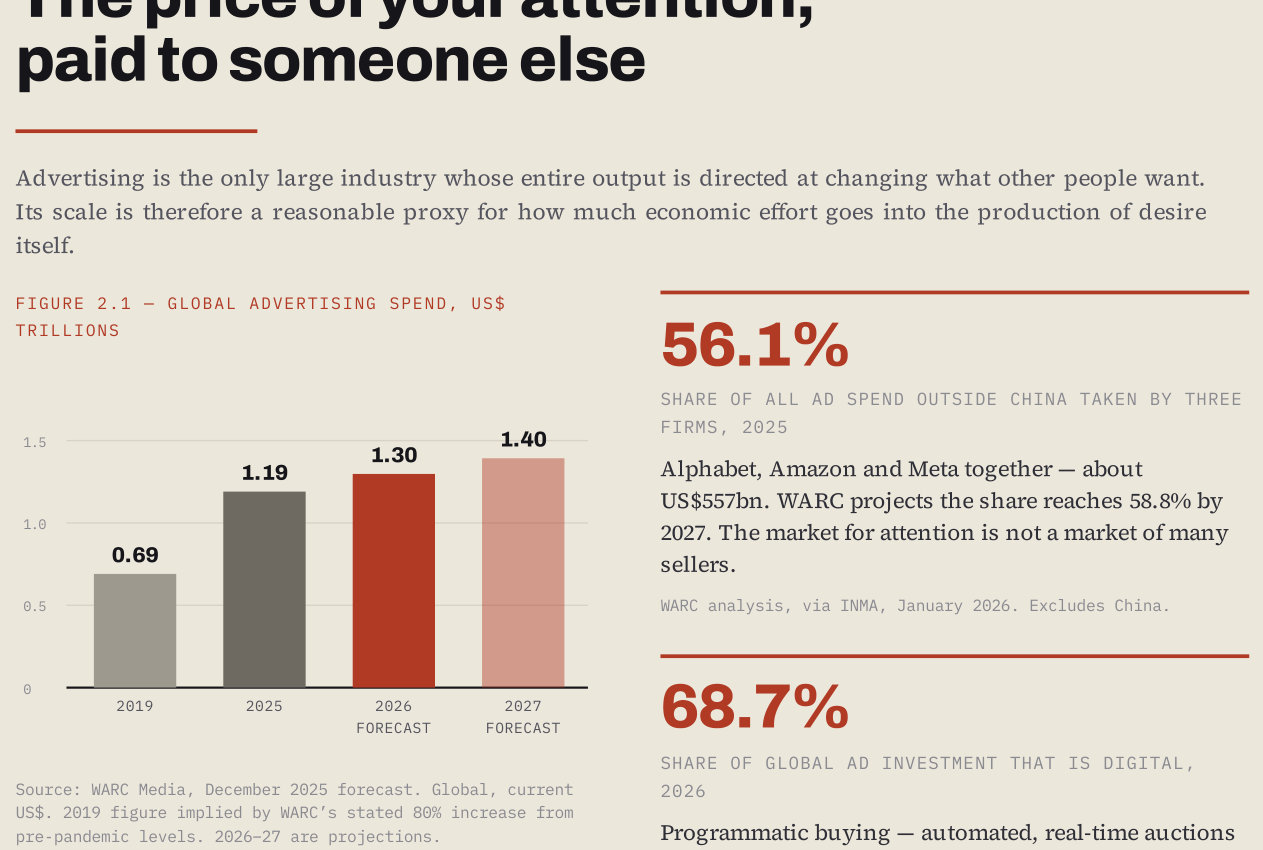
TRILLIONS 56.1% SHARE OF ALL AD SPEND OUTSIDE CHINA TAKEN BY THREE FIRMS, 2025 1.5 1.40 1.30 1.19 Alphabet, Amazon and Meta together — about US$557bn. WARC projects the share reaches 58.8% by 1.0 2027. The market for attention is not a market of many 0.69 sellers.
0.5 WARC analysis, via INMA, January 2026. Excludes China.
0 2019 2025 2026 2027 FORECAST FORECAST 68.7% SHARE OF GLOBAL AD INVESTMENT THAT IS DIGITAL, Source: WARC Media, December 2025 forecast. Global, current 2026 US$. 2019 figure implied by WARC’s stated 80% increase from pre‑pandemic levels. 2026–27 are projections. Programmatic buying — automated, real-time auctions for individual impressions — is expected to account for more than four fifths of that digital spend.
dentsu Global Ad Spend Forecasts, December 2025. Global.WHERE SOURCES DISAGREE
For 2026 the major forecasters differ by roughly a quarter of a trillion dollars: dentsu WHAT THIS BUYS about $1.04tn, WPP Media about $1.22tn, A trillion dollars a year is roughly the annual WARC about $1.30tn. They use different GDP of the Netherlands, spent entirely on the definitions of what counts as advertising. project of altering what several billion people Treat the shape of the curve as reliable and the want. decimal places as not. It would be strange to spend that and get nothing. It would be equally strange to spend it and change nothing about the culture it is spent inside. The next section is about what happens to culture when it becomes the delivery mechanism.
DIAGRAM 4
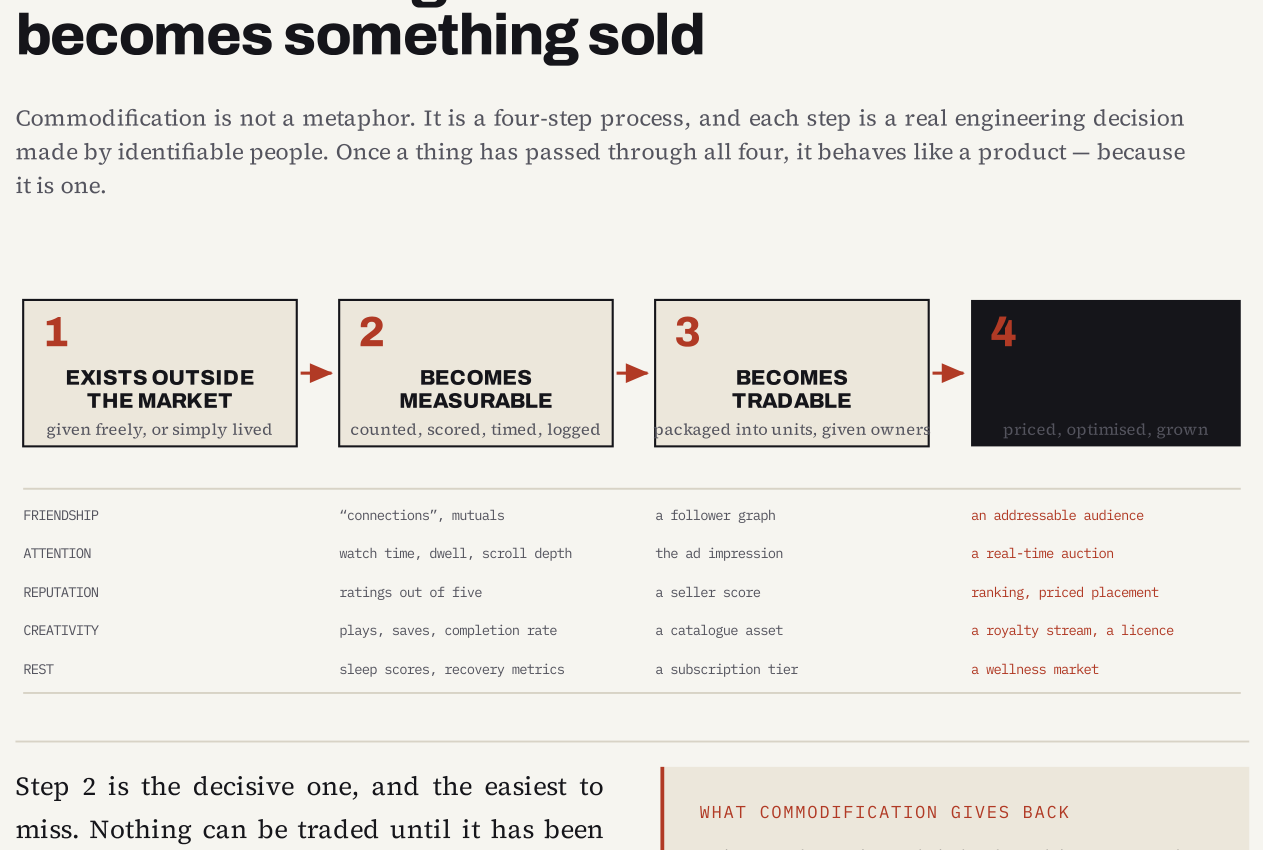
How something human becomes something sold
Commodification is not a metaphor. It is a four-step process, and each step is a real engineering decision made by identifiable people. Once a thing has passed through all four, it behaves like a product — because it is one.
1 2 3 4
EXISTS OUTSIDE          BECOMES             BECOMES             BECOMES
 THE MARKET           MEASURABLE            TRADABLE            MONETISABLE
given freely, or simply lived counted, scored, timed, logged packaged into units, given owners priced, optimised, grown
FRIENDSHIP “connections”, mutuals a follower graph an addressable audience
ATTENTION watch time, dwell, scroll depth the ad impression a real-time auction
REPUTATION ratings out of five a seller score ranking, priced placement
CREATIVITY plays, saves, completion rate a catalogue asset a royalty stream, a licence
REST sleep scores, recovery metrics a subscription tier a wellness market
Step 2 is the decisive one, and the easiest to WHAT COMMODIFICATION GIVES BACK miss. Nothing can be traded until it has been It is worth stating plainly that this process has made countable, and the act of counting is repeatedly been liberating. Making domestic never neutral — it decides which parts of a labour visible and paid was a feminist victory, thing survive the translation. not a defeat. Making healthcare a measurable service is how outcomes improved. Turning Friendship measured as a follower count keeps music into a tradable asset let musicians who reach and discards intimacy. Teaching were not aristocratic patrons’ servants earn a measured by test scores keeps what a test can living.
hold and discards the rest. The metric does not The objection is not to measurement. It is to merely describe the activity; over time it the specific case where measurement becomes the purpose of the activity rather than a record reshapes it, because everyone involved starts of it — and where the thing being measured optimising for the number. cannot survive being optimised.
This is not new. Land, labour and money all
went through the same passage, as Karl
Polanyi documented — and each transition was
socially violent at the time, then became
invisible. What is new is the speed, and the fact
that the current frontier runs through things
people previously considered interior.
PART II — THE FACTORY OF DESIRE
The frontier, and what is currently crossing it
A useful way to see an economic system is to ask what it has recently absorbed. Below: things that were mostly outside the market within living memory, and the form they now take inside it. The point is not that every entry is a tragedy. It is that the list keeps getting longer, and nothing on it has ever moved the other way.
Attention Social interaction Identity
Once the unpriced background of Once free and unrecorded. Now Once formed through family, place being awake. Now the primary input hosted on private infrastructure that and work. Increasingly assembled of a trillion-dollar industry, monetises the record of it. from purchasable signals — a subject auctioned per impression. in Part V.
Data exhaust Leisure Emotion
Behaviour that was previously Once the residual left after work. Sentiment analysis, mood-based simply behaviour. Now a tradable Now a scheduled, subscribed and recommendation, emotional asset class with no consumer price measured category of consumption. targeting in advertising. Feelings as attached to it. a segmentation variable.
Status Experience Education
Always partly purchasable. Now Travel, dining, festivals sold not as Increasingly bought as a positional
purchasable in far finer gradations, activities but as identity-confirming good — the value lying partly in and visible to far more people at events, often priced for their others not having it. once. photographability.
Housing Healthcare Childhood
Shelter and financial asset Where treatment is a market, A distinct marketing category since simultaneously, two functions with willingness to pay and urgency of the 1950s; now also a content opposed interests. See page 29. need diverge more sharply than category, with children as both
anywhere else. audience and performer.THE STRONGEST COUNTER‑ARGUMENT THE REPLY
Every item on that list is also more available This is the strongest single defence in the than it has ever been. Music that once whole document, and it should not be waved required a concert hall now costs a few away. The correct response is not to deny it hundred rupees a month for everything ever but to narrow the claim. recorded. Education that required proximity The problem is not that these goods have to a university is on a phone. prices. It is that once a good becomes a Commodification is also democratisation: market, the incentive is to make the thing that markets are indifferent to who you are, sells, which may not be the thing that works. A provided you can pay. university competes for applicants, a hospital And the nostalgia implied by “this used to be for paying procedures, a song for completion outside the market” is often false. Pre-market rate. Each may improve access while quietly societies allocated these goods too — by caste, redefining the goal. by birth, by patronage. Those systems were not freer. They were merely unpriced.
PART II — THE FACTORY OF DESIRE
The economics of things that break
A firm selling a product that lasts thirty years FIGURE 2.2 — GLOBAL E-WASTE GENERATED, MILLION TONNES has a problem it did not choose: eventually
everyone who wants one has one. A firm 90 82 selling a product that lasts three years does 62 not have that problem. 60 53.6
34“Planned obsolescence” is often stated as a 30 conspiracy — engineers instructed to design
failure. The documented cases of that are rare. 0 The ordinary mechanism is duller and far more 2010 2019 2022 2030 PROJECTED effective, and it needs no instruction at all. Source: UN Global E‑waste Monitor 2020 and 2024 (ITU/UNITAR). Durability is a cost. A component rated for ten Global, million tonnes. 2030 is a business-as-usual projection. years costs more than one rated for four. In a
competitive market with price-sensitive buyers
who cannot inspect internals, the cheaper component wins — and the firm that chose 22.3% → 20% durability loses on price. DOCUMENTED COLLECTION AND RECYCLING RATE, 2022 AND PROJECTED 2030 Repair is a competitor. A repaired device is a Generation is rising by 2.6 Mt a year; documented device not bought. Proprietary screws, glued recycling by 0.5 Mt. The recycling rate is forecast to fall batteries, paired serial numbers and software even as recycling capacity grows, because the denominator grows faster. locks are not necessarily malicious. They are UN Global E‑waste Monitor 2024. Global. simply what a firm does when repair competes
with its own sales.
Style is a clock. Where the object still works, the
fastest route to replacement is to make the
working version feel dated. Fashion cycles are not
decoration on top of the economy. They are a
replacement schedule.
THE STRONGEST COUNTER‑ARGUMENT THE REPLY
Products genuinely do improve. A 2010 phone True for the first decade of a technology, much was not merely older than a 2026 one; it was weaker once a category matures. The test is worse at almost everything. Replacement is whether the rate of replacement tracks the rate not always manufactured — sometimes the of genuine improvement. Where it does not — new thing is better, and insisting people keep and 62 million tonnes suggests it often does the old one is a demand that they accept less. not — the gap is being filled by something other than progress.
PART III — THE CULTURE INDUSTRY
Two exiles in California watching the radio
Theodor W. Adorno and Max Horkheimer CLAIM 1 — STANDARDISATION wrote the book that names this section as Cultural products made under commercial refugees in Los Angeles, having fled Nazi pressure converge on a small number of Germany. They had watched a modern, proven formulas, because a proven formula literate society organise itself around reduces risk. Variety becomes surface variety.
industrialised persuasion — then arrived in
America and found an entertainment
industry doing something that felt, to CLAIM 2 — PSEUDO-INDIVIDUALISATION them, structurally similar. Because standardisation is unappealing when visible, the industry supplies the feeling of Their book circulated privately in 1944 and was individuality — choice, personalisation, customisation — over a standardised core.published in Amsterdam in 1947 as Dialektik der Adorno introduced the term in a 1941 essay on Aufklärung. Its most-read chapter is titled, in the popular music, thirty years before anyone standard English edition, “The Culture Industry: built a recommendation algorithm. Enlightenment as Mass Deception”.
The phrase was chosen with care. They rejected “mass culture”, which implies culture arising CLAIM 3 — AMUSEMENT AS EXTENSION OF WORK
from the masses. Their claim was the opposite: Their sharpest line holds that “amusement culture manufactured for the masses, by firms, under late capitalism is the prolongation of work” — that leisure is organised to restore theunder the same logic as any other manufacture. worker for Monday rather than to free them. “Industry” was meant literally, not as insult. Entertainment that demands nothing is restful precisely because the day already demanded Much of the book is dense, pessimistic and, in everything. places, snobbish. Adorno’s judgements on jazz
have not aged well, and his assumption that
audiences are passive was challenged for decades
by researchers who found them doing
something far more active. But strip away the
tone and three claims remain, each testable
against evidence they never lived to see.
How this document uses them
As a hypothesis, not an authority. They described radio,
cinema and magazines — media with no feedback loop, where a studio guessed what audiences wanted and learned the answer months later at the box office. Every mechanism they identified has since been fitted with real-time measurement. The next pages ask what the
evidence shows.
PART III — THE CULTURE INDUSTRY
Standardisation
The hypothesis: under commercial pressure, apparently different products converge on the same underlying formula. This is the most easily falsifiable of the three claims, because the entertainment industry publishes its results.
DIAGRAM 3 — MANY SURFACES, ONE STRUCTURE
 SUPERHERO FILM


   TALENT SHOW
                                                                             • a proven property or familiar face
                                     THE SAME• an emotional beat every few minutes
STREAMING THRILLER RISK-MINIMISING• a first thirty seconds built to stop exit TEMPLATE • an ending that permits a sequel MOBILE GAME • tested against measured audience response
INFLUENCER VLOGConceptual model. The claim is not that these products are identical, but that commercial risk management pushes very different- looking formats toward a shared underlying structure.
−33%9 of 10 73%TOP US DOMESTIC BOX-OFFICE FILMS OF 2025 US DOMESTIC BOX OFFICE FALL IN US DOMESTIC SEQUEL GROSS, FROM EXISTING IP, 2025 FROM FRANCHISE OR IP-BASED FILMS 2024 TO 2025
Only one original title — Sinners — In 2019, franchise films took an Evidence cuts the other way too. reached the top ten. In 2024 all ten estimated 82.5% of worldwide box Sequel revenue fell sharply, several came from existing IP. office. The direction has been large franchise entries consistent for more than a decade. underperformed, and original filmsComscore data via CNBC, Jan 2026. US domestic. drew audiences. Standardisation is a Industry box-office analysis, 2026. US domestic / worldwide. pressure, not a law.
                                                                                     IndieWire box-office analysis, Aug 2026.
                                                                                    US domestic.
PART III — THE CULTURE INDUSTRY
Pseudo‑individualisation
The hypothesis: standardisation is unappealing when visible, so the system supplies the feeling of individuality over a standardised core. Adorno named this in 1941, describing popular songs. It is now the operating principle of most consumer software.
The mechanism is easy to state. Offer the THE TELL customer a large number of choices within a A reliable test for pseudo-individualisation: structure they cannot choose. The choices are ask what happens if you want something real; the structure is not up for negotiation. outside the option set. A genuinely Because the choosing feels effortful and individualised system can accommodate it, personal, the standardisation underneath usually at a price. A pseudo-individualised one cannot represent the request at all — there becomes invisible. is no field for it.
A streaming service gives you a home screen You can choose any of forty thousand titles. assembled uniquely for you from a catalogue You cannot choose that a film be ninety assembled for everyone. The arrangement is minutes long, or that the service stop autoplaying. The variables that matter are not personal. The inventory is not. Two people exposed. with entirely different tastes are shown
different doors into the same building.
Fast fashion sells thousands of distinct THE STRONGEST COUNTER‑ARGUMENT garments produced on a handful of silhouettes All culture is formula. Sonnets have fourteen and four or five fabric bases. A phone comes in lines; ragas have rules; the twelve-bar blues is six finishes and one design. A playlist is “made a template, and nobody thinks Robert Johnson was a victim of standardisation. for you” and shared, in substance, with several Constraint is where craft lives, and audiences hundred thousand people in the same enjoy familiar structures for reasons that have behavioural cluster. nothing to do with capitalism.
What makes this more than a complaint about Personalisation also does something plainly good: it surfaces work that would otherwise marketing is the direction of the effect. never have found its audience. A Malayalam Personalisation does not only sell the product film reaching a viewer in Warsaw is not a loss — it also transfers the sense of authorship to the of individuality.
buyer. You did not receive a standard object;
you curated one. Dissatisfaction therefore reads
as personal failure of taste rather than as a THE REPLY
limitation of what was on offer. The difference is who sets the constraint and why. A sonnet’s form is public, stable and available to be broken deliberately. A recommendation system’s constraints are private, shifting, and optimised against a metric the audience never sees and cannot contest.
PART III — THE CULTURE INDUSTRY
Entertainment after work
The hypothesis: leisure under industrial capitalism is organised to restore the worker rather than to free them. This is the claim that ages best in mechanism and worst in tone — and the one that must be stated most carefully.
The argument is not that entertainment is bad,
or that people who enjoy it are dupes. It is an 18h 36m argument about what kind of entertainment WEEKLY TIME ON SOCIAL AND VIDEO FEEDS, TYPICAL INTERNET USER, 2026 succeeds when the audience arrives exhausted. Around 16% of waking hours — roughly 2½ hours a Work that is cognitively demanding, day. Among women aged 16 to 24 the figure is 25h 45m a week, over 3h 40m daily. emotionally regulated and continuously DataReportal / GWI, Digital 2026 Global Overview. Global. monitored leaves a specific deficit at the end of
the day. What relieves that deficit is content demanding nothing: no unfamiliar structure, WHERE THIS CLAIM MUST BE LIMITED
no ambiguity, no sustained attention, no risk of Three qualifications, all necessary.
being confused. Content that does demand Not all entertainment is passive. Games those things is, at 10pm on a Tuesday, demand skill acquisition; fandoms produce indistinguishable from more work. enormous volumes of original work; a great deal of the most demanding art of the last So the commercial filter from page 5 applies to century was commercially produced and culture with a particular slant. It does not commercially successful.
select against difficulty out of malice. It selects Rest is legitimate. A person entitled to relief against difficulty because difficulty loses, after a hard day is not failing a test. The critique is of the industry’s incentives, not thereliably, to the tired. viewer’s choices.
Adorno and Horkheimer put this as a single The mechanism is conditional. Passive line: amusement under late capitalism is the consumption is what happens under specific prolongation of work. The evidence they could conditions — exhaustion, infinite supply, zero not have had is the shape of modern marginal cost of continuing, and a revenue model paid by the hour. Change those consumption — not that people watch, but how: conditions and the effect weakens. in fragments, alongside a second screen, at
increased playback speed, with autoplay
removing the moment of decision entirely.
The strongest version of the claim is narrow
and defensible: when leisure is bought from
firms whose revenue depends on time spent,
the format that wins will be the one that is
hardest to stop, not the one that is most
nourishing. Those are different optimisation
targets, and only one of them is measured.
DIAGRAM 7
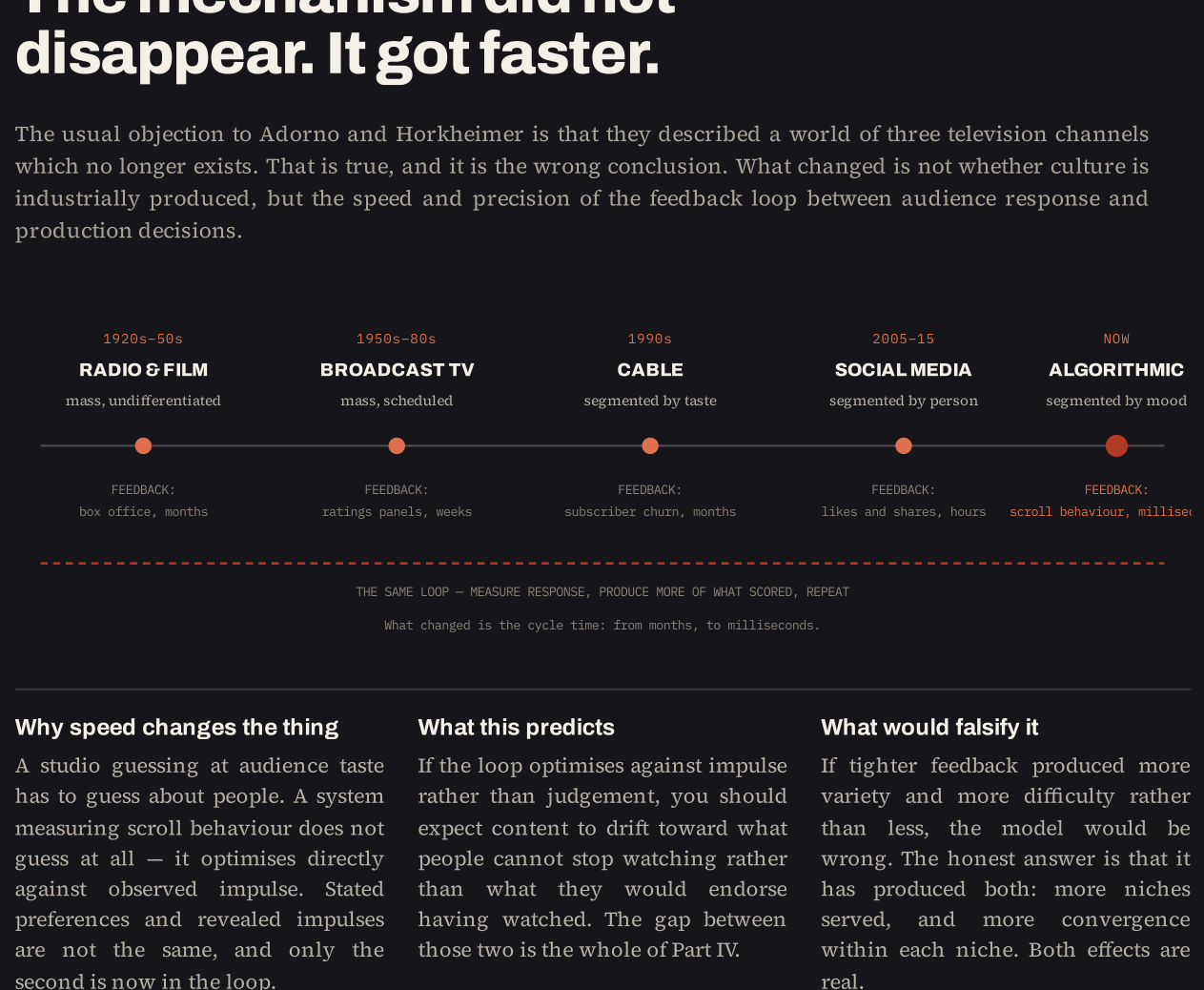
The mechanism did not disappear. It got faster.
The usual objection to Adorno and Horkheimer is that they described a world of three television channels which no longer exists. That is true, and it is the wrong conclusion. What changed is not whether culture is industrially produced, but the speed and precision of the feedback loop between audience response and production decisions.
      1920s–50s                    1950s–80s                      1990s                       2005–15                    NOW

 RADIO & FILM        BROADCAST TV           CABLE             SOCIAL MEDIA      ALGORITHMIC

  mass, undifferentiated               mass, scheduled                segmented by taste             segmented by person        segmented by mood


         FEEDBACK:                          FEEDBACK:                          FEEDBACK:                          FEEDBACK:                     FEEDBACK:
     box office, months                ratings panels, weeks             subscriber churn, months            likes and shares, hours   scroll behaviour, millisec


                                          THE SAME LOOP — MEASURE RESPONSE, PRODUCE MORE OF WHAT SCORED, REPEAT

                                               What changed is the cycle time: from months, to milliseconds.
Why speed changes the thing What this predicts What would falsify it
A studio guessing at audience taste If the loop optimises against impulse If tighter feedback produced more has to guess about people. A system rather than judgement, you should variety and more difficulty rather
measuring scroll behaviour does not expect content to drift toward what than less, the model would be guess at all — it optimises directly people cannot stop watching rather wrong. The honest answer is that it against observed impulse. Stated than what they would endorse has produced both: more niches preferences and revealed impulses having watched. The gap between served, and more convergence are not the same, and only the those two is the whole of Part IV. within each niche. Both effects are
second is now in the loop. real.
DIAGRAM 2
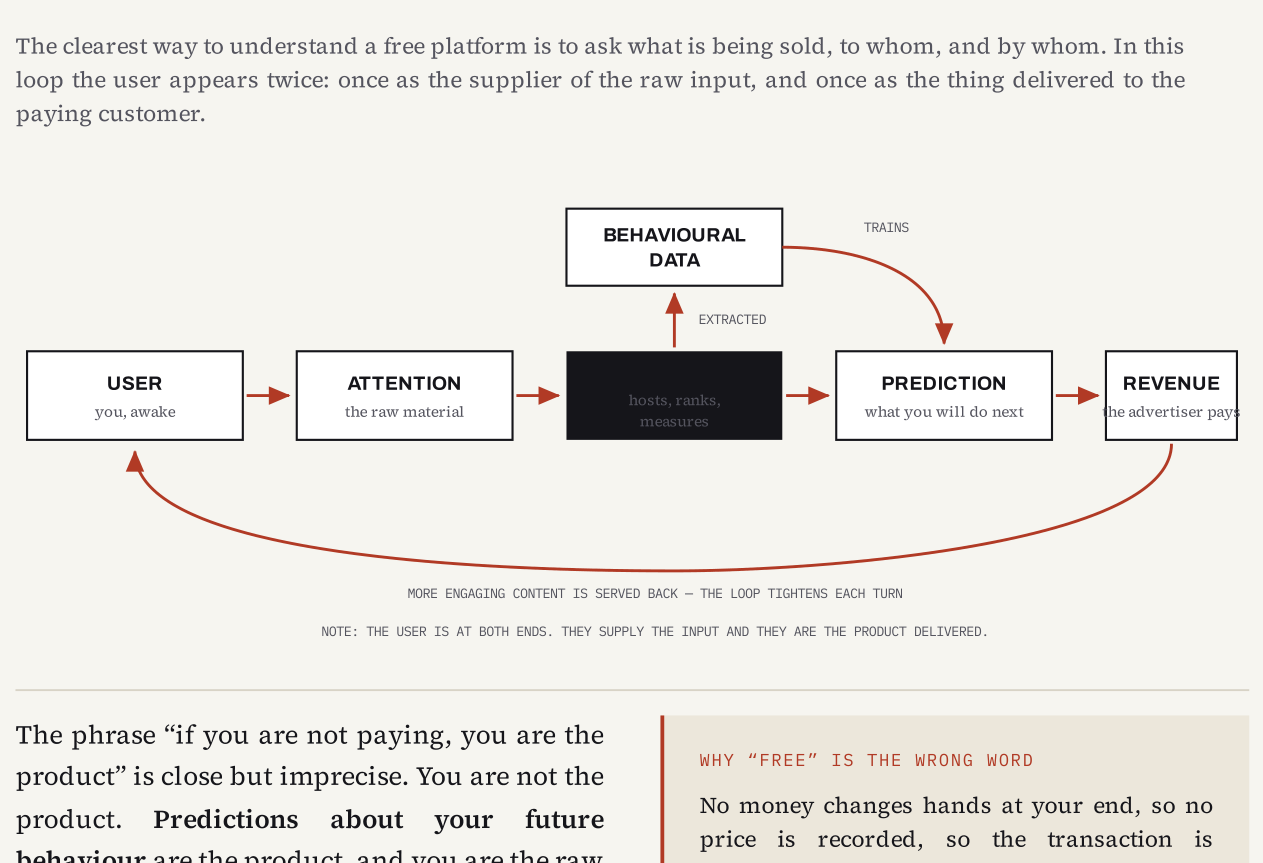
The attention economy
The clearest way to understand a free platform is to ask what is being sold, to whom, and by whom. In this
loop the user appears twice: once as the supplier of the raw input, and once as the thing delivered to the paying customer.
                                         BEHAVIOURAL                TRAINS
                                             DATA


                                                                                      EXTRACTED


                                         PLATFORM
   USER               ATTENTION                                  PREDICTION        REVENUE
                                                                                hosts, ranks,
      you, awake                      the raw material                                             what you will do next          the advertiser pays
                                                                    measures


                                               MORE ENGAGING CONTENT IS SERVED BACK — THE LOOP TIGHTENS EACH TURN

                                    NOTE: THE USER IS AT BOTH ENDS. THEY SUPPLY THE INPUT AND THEY ARE THE PRODUCT DELIVERED.
The phrase “if you are not paying, you are the WHY “FREE” IS THE WRONG WORD product” is close but imprecise. You are not the No money changes hands at your end, so no product. Predictions about your future price is recorded, so the transaction is behaviour are the product, and you are the raw invisible to every economic statistic. GDP material from which they are refined. registers the advertiser’s spend and the platform’s revenue. It registers nothing on That distinction matters because it explains the your side of the ledger. design. If attention alone were being sold, a Return to page 5: an unpriced cost is a platform would only need you to look. Because structural blind spot, not an accounting error. predictions are being sold, and predictions The attention economy is the largest such improve with data, the platform needs you to blind spot ever constructed — roughly two and a half hours per person per day, worldwide, keep acting — scrolling, pausing, reacting, that appears in no national account as a cost searching — so that the model of you sharpens. of anything.
This is what Shoshana Zuboff named
surveillance capitalism: an arrangement in
which human experience is claimed as free raw
material for translation into behavioural data,
some of which improves the service while the
remainder is sold as a prediction product.
PART IV — THE ATTENTION ECONOMY
Where the day goes
FIGURE 4.1 — A TYPICAL INTERNET USER’S DAY, HOURS
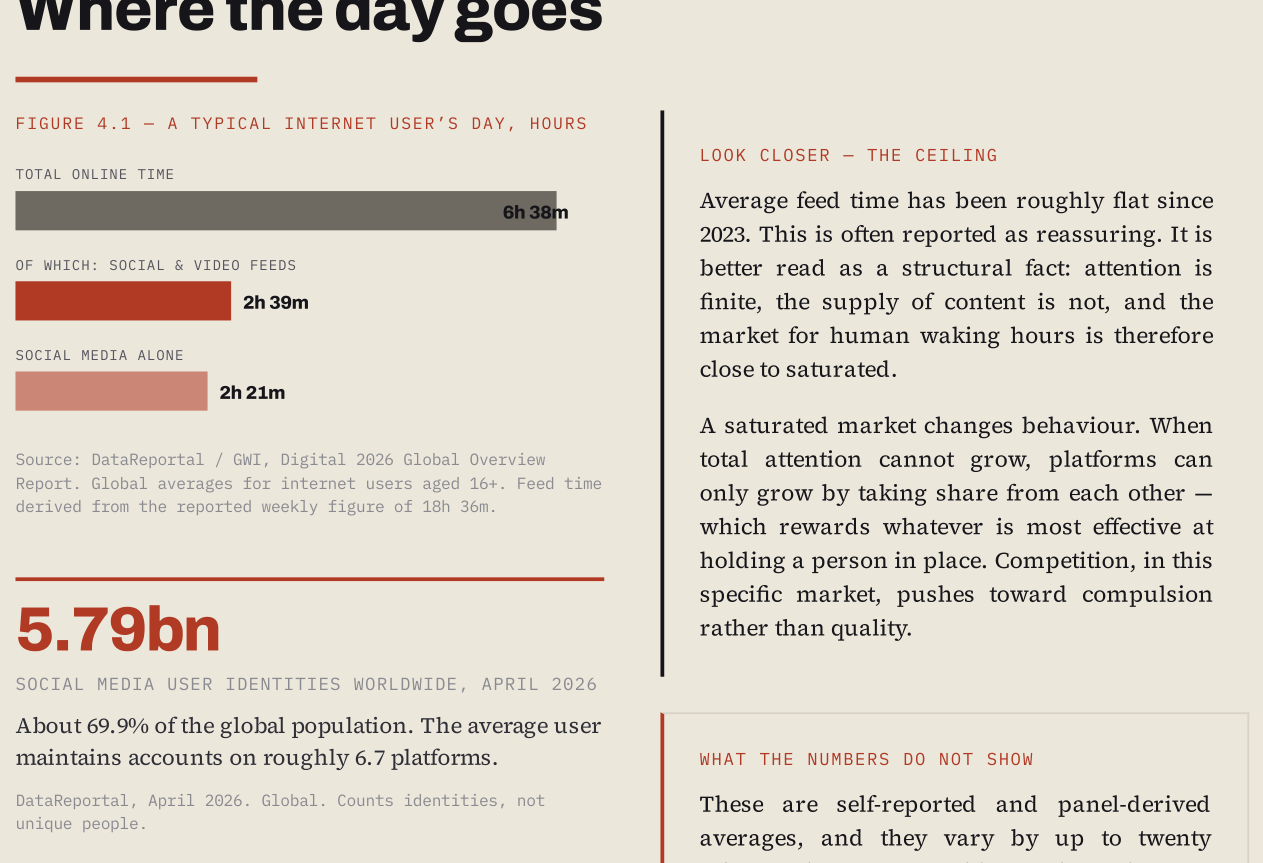
LOOK CLOSER — THE CEILINGTOTAL ONLINE TIME 6h 38m Average feed time has been roughly flat since 2023. This is often reported as reassuring. It is OF WHICH: SOCIAL & VIDEO FEEDS better read as a structural fact: attention is 2h 39m finite, the supply of content is not, and the market for human waking hours is therefore SOCIAL MEDIA ALONE close to saturated. 2h 21m
A saturated market changes behaviour. WhenSource: DataReportal / GWI, Digital 2026 Global Overview total attention cannot grow, platforms can Report. Global averages for internet users aged 16+. Feed time only grow by taking share from each other —derived from the reported weekly figure of 18h 36m. which rewards whatever is most effective at holding a person in place. Competition, in this specific market, pushes toward compulsion rather than quality.5.79bn SOCIAL MEDIA USER IDENTITIES WORLDWIDE, APRIL 2026
About 69.9% of the global population. The average user maintains accounts on roughly 6.7 platforms. WHAT THE NUMBERS DO NOT SHOW
DataReportal, April 2026. Global. Counts identities, not These are self-reported and panel-derived unique people. averages, and they vary by up to twenty minutes between providers. They also say nothing about what the time was spent on: a video call with family and an hour of autoplay are counted identically.
                                            Anyone who  tells you  that screen time  is

                                                       straightforwardly        harmful,        or
                                                       straightforwardly harmless, is going beyond
                                              what this evidence can support. The research
                                                              literature on mental-health effects is genuinely
                                                          contested, with effect sizes that shrink under
                                                                  stricter methods.


                                     Attention is the only input in this
                            economy that cannot be
                                 manufactured, imported, or grown.
PART IV — THE ATTENTION ECONOMY
The four things being sold that you never listed
A conventional market sells goods to consumers. A platform market sells 56.1% consumers to firms. Understanding the OF AD SPEND OUTSIDE CHINA GOING TO THREE FIRMS, 2025second requires being specific about what, exactly, is in the inventory. Alphabet, Amazon and Meta. Rising to a projected 58.8% by 2027. The buyers of attention are many; the sellers are effectively three.
- Attention WARC analysis via INMA, January 2026. Excludes China. The simplest product: a quantity of your
awareness, sold by the impression, in an WHY THIS IS NOT THE SAME AS OLD auction that resolves in under a hundred ADVERTISING milliseconds. Programmatic buying now A billboard cannot tell who looked at it. That accounts for roughly four fifths of digital ad limitation was, in effect, a privacy guarantee — investment. and it also capped how precisely persuasion could be aimed. 2. Behavioural data The removal of that cap is the whole Not what you posted — what you did. Dwell innovation. Targeting is no longer demographic but behavioural and temporal: time, rewatches, hesitation before a tap, the not “men aged 25–34” but “this person, in this hour you are most suggestible. This is the mood, at 11.40pm, who has looked at this residue of using the service, and it was never category three times this week without part of the exchange you agreed to. buying”.
Persuasion aimed at a population can be3. Your social graph resisted collectively. Persuasion aimed at one Who you know, how closely, and how influence person at their least resistant moment is a different kind of problem, and our institutions propagates between you. This has value were built for the first kind. independent of anything you personally do,
which is why platforms fight hard to keep it
non-portable. THE STRONGEST COUNTER‑ARGUMENT 4. Predictions This bargain has delivered genuinely enormous value at zero monetary cost: global The refined product. Not what you want now communication, free navigation, free but what you will likely want, buy, believe or translation, free access to most recorded vote for. Predictions about the future are worth human knowledge. Hundreds of millions of far more than records of the past, and they are people who could never have paid for these things use them daily. Calling that the reason the data is worth collecting at all. exploitation requires ignoring what the other side of the ledger contains.
PART IV — THE ATTENTION ECONOMY
When does a feed become passive?
Not all algorithmic consumption is passive, and treating it as such is both wrong and condescending. It is more useful to identify the specific conditions under which active use reliably degrades into passive use — because those conditions are design choices, and design choices can be different.
The four conditions THE ACTIVE-AUDIENCE CORRECTION1. The decision to continue is removed. Autoplay and infinite scroll eliminate the stopping point. A choice From the 1970s onward, media researchers you never make is a choice you cannot make well. demonstrated repeatedly that audiences are 2. Supply is effectively infinite. When a magazine not receivers but interpreters. People decode ended, the ending was structural. Nothing in a feed messages against their own experience, ends. frequently against the intended meaning; fan communities produce vast quantities of 3. Reward timing is variable. Occasional unpredictable original work; political content is argued with payoff among mostly unremarkable items produces the rather than absorbed. most persistent engagement pattern known to behavioural psychology. Feeds did not invent this; slot This is the most serious problem with machines did. Adorno’s version of the argument, and it 4. The optimisation target is time, not satisfaction. If should be conceded rather than managed. revenue is proportional to hours, the system has no Audiences are active. signal distinguishing an hour you valued from an hour The narrower claim that survives: activity is you regretted. not the same as agency. A person can be highly Where all four hold, consumption becomes passive for engaged — commenting, arguing, creating — most people most of the time. Where any one is absent inside an environment whose agenda, ranking — a paid service with no ads, a finite episode count, a and stopping rules were all set by someone deliberate search — the effect weakens sharply. The else, and measured against a target they have mechanism is conditional, which is also what makes it no access to. addressable.
                                                              A TEST YOU CAN RUN

                                                  At the end of a session, ask whether you would
                                               have chosen  it in advance. Regret is not a
                                                      rigorous instrument, but it is the only signal
                                                          in this system that is not being collected —
                                               which is precisely why  it is the one worth
                                                       attending to.
PART V — IDENTITY FOR SALE
Your identity as a marketplace
For most of history, who you were was THE THREE-WAY TRADE mostly decided for you — by family, You get a legible self, assembled faster than caste, village, trade, religion. That any traditional society allowed, and revisable arrangement was oppressive in ways at will. nobody should want back. Its The firm gets a customer whose repeat replacement is genuine freedom: you purchase is now tied not to utility but to self- continuity. Switching brands becomes a small may now construct an identity. The identity cost, which is far stickier than any question this section asks is what loyalty scheme. materials are available for the The platform gets the record. Identity construction, and who supplies them. performed publicly is identity that can be measured, clustered and sold as a prediction.
When inherited identity weakens and self-made
identity takes its place, a gap opens. It has to be
filled with signals — things visible to others that WHY THIS IS THE HINGE OF THE DOCUMENT
communicate what kind of person you are. Some Once identity is partly constituted by signals are unpurchasable: skill, reputation, how consumption, the ordinary defences against you treat people. Most are slow to acquire. advertising stop working. You can be sceptical of a claim about a product. It is much harder Purchasable signals are fast. A brand, a phone, a to be sceptical of a claim about yourself.
neighbourhood, a holiday, a diet, a team, a It also explains the phenomenon on the next political affiliation worn as a style. They are page, which otherwise makes no sense at all: legible immediately, and they can be acquired people defending enormous corporations, this afternoon. and the individuals who own them, with the emotional intensity of self-defence. The result is not that people are shallow. It is that
the market has a structural advantage in
supplying identity components, because it can
produce them on demand and deliver them
quickly, while the alternatives cannot.
This is not new The counter‑argument The reply
Thorstein Veblen described Objects have always carried Agreed — the objection is not to conspicuous consumption in 1899: meaning — wedding rings, uniforms, meaningful objects. It is to the spending whose purpose is to heirlooms. Treating purchased specific case where the meaning is display the capacity to spend. What meaning as fake and inherited supplied by the seller, arrives pre-
is new is the audience size. Veblen’s meaning as authentic is a distinction attached, and is engineered to expire status competition ran against a few that does not survive examination. A on a schedule that matches the dozen neighbours. Yours runs guitar someone saved for is not a product cycle. against everyone you have ever met, lesser object than one handed down. continuously, with photographs.
PART V — IDENTITY FOR SALE
Why people defend brands, billionaires and celebrities
A person with no equity in a company, no relationship with its founder and no prospect of either will nonetheless argue for hours on its behalf, unpaid, against strangers. This looks irrational. It is not. It is an entirely rational defence of something that genuinely belongs to them.
The mechanism, in five steps THE POLITICAL VERSION1. Parasocial attachment. Sociologists Horton and Wohl described this in 1956, watching television: Every step above applies unchanged when the sustained one-sided exposure to a person produces the object is a political figure. A voter who has felt texture of friendship. Human social machinery fused a politician into their self-description evolved with no defence against faces that appear daily will process contrary evidence as an attack — and never look back. Streaming and vertical video have which is why factual correction so often made the exposure continuous and intimate. strengthens rather than weakens the position.
-
Tribal affiliation. Group identity is among the most This is why political discourse increasingly robust findings in social psychology, and it forms on resembles fandom: same mechanism, samealmost nothing. Once a boundary exists, in-group defence follows automatically. infrastructure, same reward for intensity. Merchandise, rivalries, in-jokes, and the sense
-
Brand communities. Firms now deliberately build that the opposing side is not merely wrong but the boundary: launch events, membership tiers, an a different kind of person. ecosystem you are inside or outside, a rival to be against.
The uncomfortable implication is that this is -
Identity fusion. Once the affiliation is part of self- not a failure of citizens. It is what the description, criticism of the object is processed as machinery reliably produces when political criticism of the self. The defence is not calculated. It is identity is distributed through systems built to felt. maximise engagement.
-
Algorithmic reinforcement. The feed observes which content produces the strongest reaction and supplies
more of it. Fandom and outrage are both high- engagement states, so both are amplified by a system THE STRONGEST COUNTER‑ARGUMENT indifferent to which it is. Belonging is a real human good, not a con. A football crowd, a fan community, a group that welcomes a lonely teenager — these provide something genuine that the people inside them are not wrong to value. Describing all of it as manufactured is both inaccurate and dismissive of people’s actual lives.
                                         And  consumers  are  not  helpless:  brand
                                                communities regularly turn on the firms that
                                                            built them, and boycotts and backlashes are
                                                       frequent enough  to prove the relationship
                                                 runs both ways.
PART V — IDENTITY FOR SALE
The economics of status
Status has one property that makes it WHY THIS IS PROFITABLE economically extraordinary: it cannot be A satisfied customer is a commercial problem. mass-produced. If everyone gains it, nobody A customer who feels slightly behind is a has. This makes it the perfect commodity, recurring one. because demand for it can never be satisfied. No individual firm needs to intend this. Any firm whose advertising successfully evokes a Most goods exhibit diminishing returns. The small deficit outsells one that does not, and the second coat is worth less than the first; the tenth filter from page 5 does the rest. The aggregate is worth almost nothing. Positional goods do not effect is an economy with a structural interest behave this way, because their value depends in a mild, permanent, widely distributed entirely on the gap between what you have and sense of inadequacy.
what others have.
This is why rising prosperity does not produce THE STRONGEST COUNTER‑ARGUMENT rising contentment as reliably as one would Status competition long predates capitalism expect. Absolute conditions improve while and appears in every human society ever relative position stays roughly constant, and a studied, including those with no markets at substantial part of what people were chasing was all. Blaming an economic system for a relative all along. universal feature of social primates is a category error. What social media changed And status competition drives real effort: Not the existence of status competition — that is people build, train, study and create partly to be seen doing it. Remove the motive and a ancient. What changed is the reference group. For great deal of human achievement goes with it. nearly all of human history, you compared
yourself with people you could see: neighbours,
colleagues, relatives. The comparison was THE REPLY demanding but bounded, and the people in it were roughly like you. Both true. The claim is not that capitalism invented status but that it industrialised it — The reference group is now unbounded and converting a universal human tendency into a monetisable input, then buildingselected for the top of every distribution infrastructure that measures and intensifies it simultaneously. You are comparing your continuously, because doing so is profitable. ordinary life against a feed assembled from the
best moments of several thousand people,
filtered by an algorithm that has learned exactly
which comparisons hold your attention longest.
The mathematics of that are unforgiving. In a
bounded group you can plausibly be near the top
of something. Against an unbounded one, there
is always someone further ahead, and the system
is designed to show them to you.
PART VI — THE LOOP
Work, productivity and pay
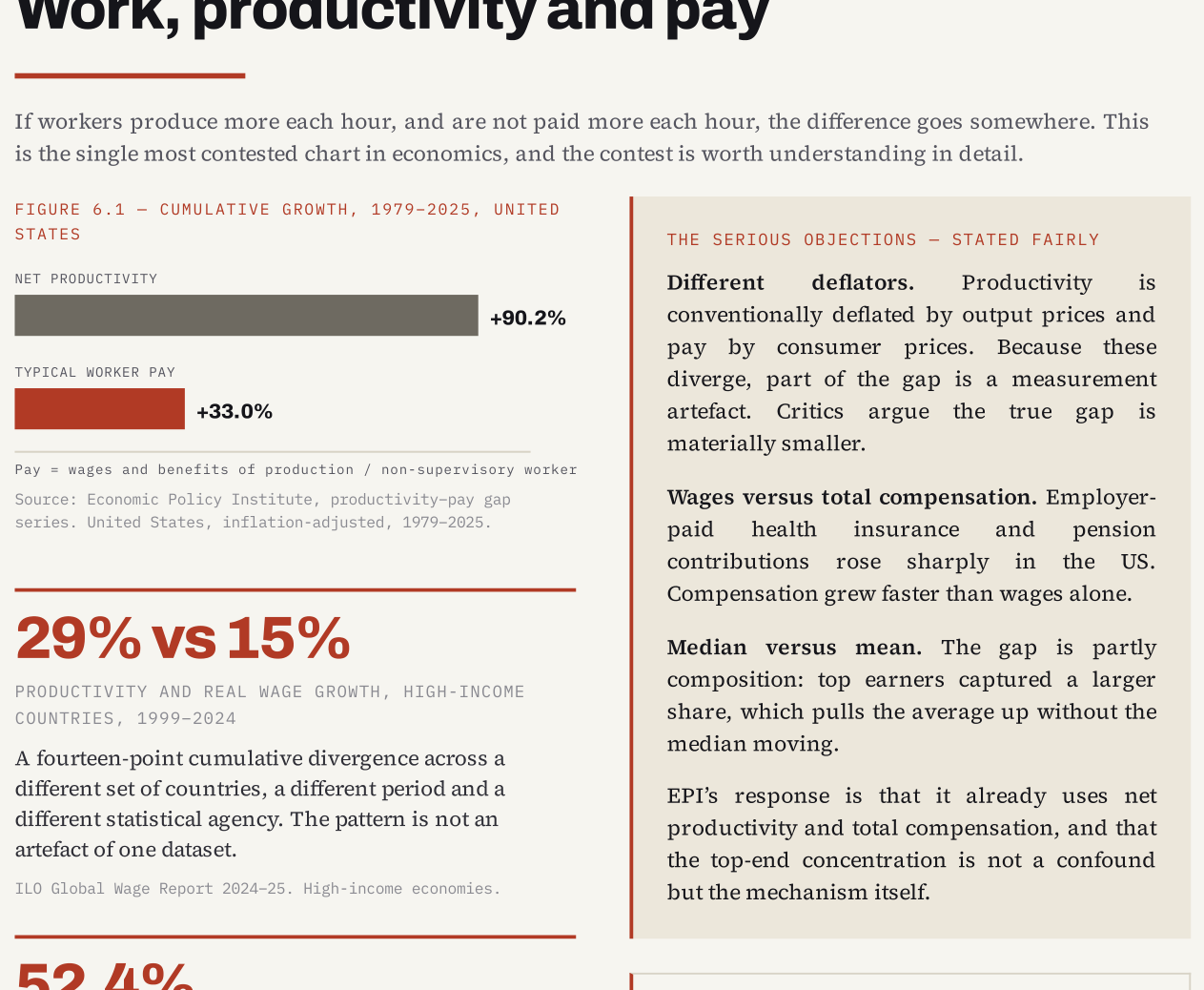
If workers produce more each hour, and are not paid more each hour, the difference goes somewhere. This is the single most contested chart in economics, and the contest is worth understanding in detail.
FIGURE 6.1 — CUMULATIVE GROWTH, 1979–2025, UNITED
STATES THE SERIOUS OBJECTIONS — STATED FAIRLY
NET PRODUCTIVITY Different deflators. Productivity is +90.2% conventionally deflated by output prices and pay by consumer prices. Because these TYPICAL WORKER PAY diverge, part of the gap is a measurement +33.0% artefact. Critics argue the true gap is materially smaller. Pay = wages and benefits of production / non-supervisory worker Source: Economic Policy Institute, productivity–pay gap Wages versus total compensation. Employer- series. United States, inflation-adjusted, 1979–2025. paid health insurance and pension contributions rose sharply in the US. Compensation grew faster than wages alone.
                                             Median  versus mean. The gap  is  partly29% vs 15%
                                                     composition: top earners captured a largerPRODUCTIVITY AND REAL WAGE GROWTH, HIGH-INCOME
COUNTRIES, 1999–2024 share, which pulls the average up without the median moving. A fourteen-point cumulative divergence across a different set of countries, a different period and a EPI’s response is that it already uses net different statistical agency. The pattern is not an productivity and total compensation, and that artefact of one dataset. the top-end concentration is not a confound ILO Global Wage Report 2024–25. High-income economies. but the mechanism itself.
52.4% WHAT SURVIVES THE OBJECTIONS LABOUR’S SHARE OF GLOBAL INCOME, 2024 Strip out everything disputed and one finding Down from 53% in 2014 and 1.6 points lower than 2004. holds across datasets, countries and agencies: The ILO estimates that holding the 2004 share would the share of national income going to labourhave meant $2.4 trillion more in worker income in 2024 has fallen, and the share going to owners ofalone. capital has risen. That is measured directly, ILO, World Employment and Social Outlook, 2024 and May 2025 updates. Global. needs no deflator choice, and is not in serious dispute.
                                                                      Its  consequence  matters  more  than  the
                                                       percentage. Income from work and income
                                               from   ownership   are   distributed   very
                                                             differently —  so a  shift between them  is
                                                      automatically  a  shift  toward  those who
                                                    already hold assets.
DIAGRAM 5
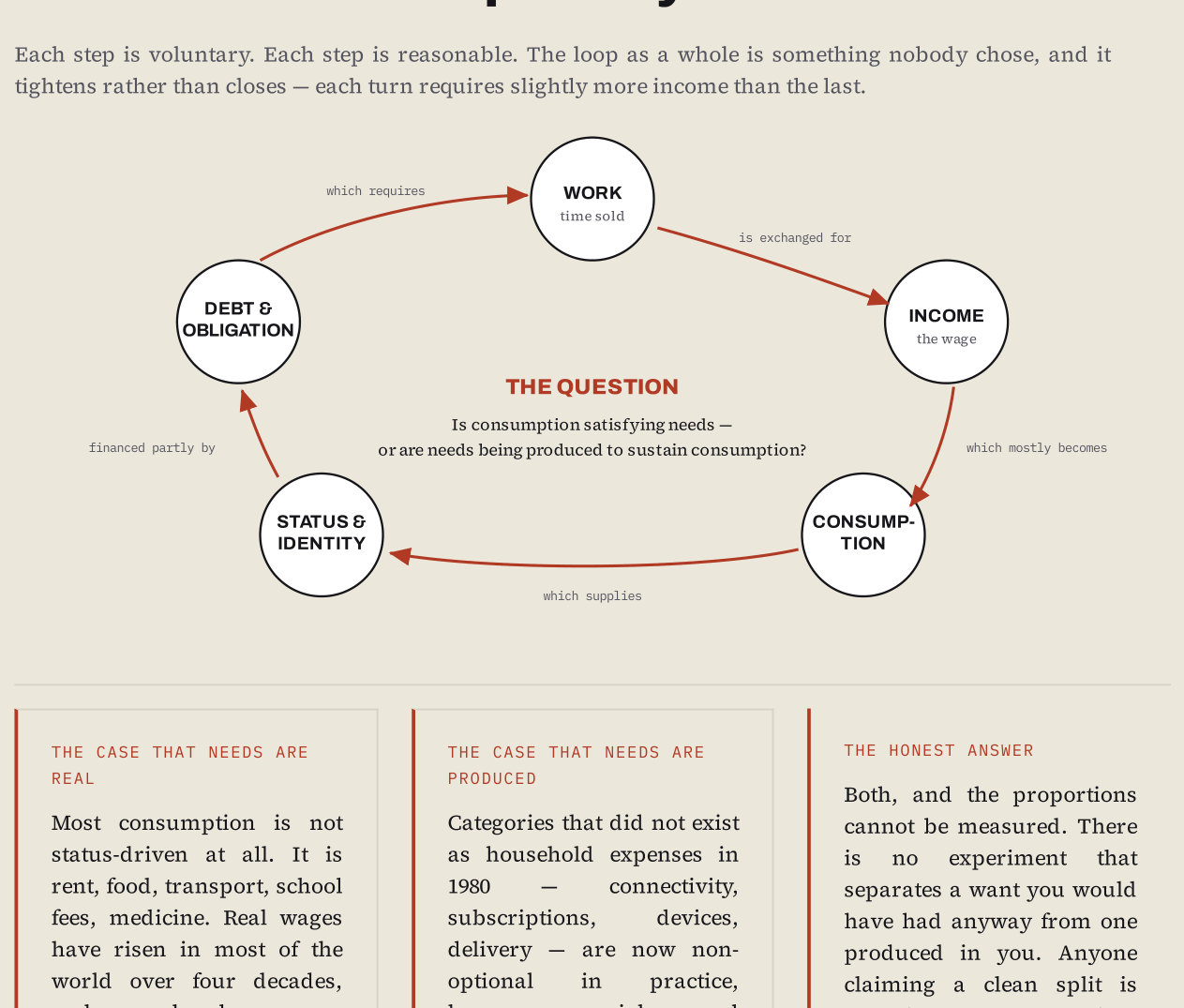
The work–consumption cycle
Each step is voluntary. Each step is reasonable. The loop as a whole is something nobody chose, and it
tightens rather than closes — each turn requires slightly more income than the last.
                                        which requires         WORK

                                                                time sold
                                                                                               is exchanged for


           DEBT &                                                                       INCOME
           OBLIGATION
                                                                                                                          the wage

                           THE QUESTION

                                                      Is consumption satisfying needs —
      financed partly by                  or are needs being produced to sustain consumption?                      which mostly becomes


                  STATUS &                                   CONSUMP-
                    IDENTITY                                          TION


                                                                      which supplies
THE CASE THAT NEEDS ARE THE CASE THAT NEEDS ARE THE HONEST ANSWER REAL PRODUCED Both, and the proportions Most consumption is not Categories that did not exist cannot be measured. There status-driven at all. It is as household expenses in is no experiment that rent, food, transport, school 1980 — connectivity, separates a want you would fees, medicine. Real wages subscriptions, devices, have had anyway from one have risen in most of the delivery — are now non- produced in you. Anyone world over four decades, optional in practice, claiming a clean split is and people buy more because social and asserting, not measuring. because they can afford professional life has What can be measured is the more — which is what reorganised around them. loop’s effect on balance progress looks like. A want, once universal, sheets — which is the next Treating ordinary becomes a need without page. purchases as manufactured anyone deciding it should. desire insults the people making them.
PART VI — THE LOOP
Debt: buying the future to pay for the present
Credit is what allows consumption to exceed income. At the level of an individual it is a tool. At the level of a system it is the mechanism by which demand keeps growing when wages do not.
$18.8tn $1.26tn 45.5% 58.4% TOTAL US HOUSEHOLD DEBT, US CREDIT CARD BALANCES, INDIAN HOUSEHOLD DEBT AS SHARE OF INDIAN Q2 2026 Q2 2026 A SHARE OF GDP, 2026 HOUSEHOLD BORROWING THAT IS NON-HOUSING RETAIL Mortgages $13.1tn, auto Up from $770bn at the Up from around 33% in CREDIT loans $1.71tn, student pandemic trough in Q1 2018–19. The RBI flags the loans $1.65tn, credit cards 2021 — an increase of composition as the Largely unsecured and $1.26tn. 4.7% of balances $493bn in five years. concern, not the level. consumption-oriented: were in some stage of NY Fed via LendingTree, 2026. RBI Financial Stability personal loans, cards, delinquency. US. Report, June 2026. India. durables, vehicles. Unlike a mortgage, it creates no NY Fed, Household Debt & Credit, Aug 2026. US. asset.
                                                                                               RBI Financial Stability
                                                                                                Report, June 2026. India.
Two facts about Indian households sit awkwardly WHAT CREDIT GENUINELY MADE POSSIBLE together. Net financial savings fell to roughly 5% Almost nobody could buy a house fromof GDP in 2022–23, a multi-decade low, before savings. Credit is what converted home recovering to 7% of gross national disposable ownership from an inherited privilege into income in 2024–25. Over the same stretch, something a salaried worker could reach, and household debt climbed steadily — a population the same applies to education, vehicles and borrowing to consume rather than to build small business formation.
assets. The RBI’s framing is watchfulness rather Access to credit has been one of the sharpest than alarm, and India’s ratio stays below most lines between the included and excluded — comparable emerging economies. But the which is why extending it to women and to the direction of travel is what to notice, not the level. rural poor was a genuine expansion of freedom, not a trap. Debt does something to the loop on the previous
page that nothing else does: it makes the cycle
non-optional. A person with obligations cannot THE DISTINCTION THAT MATTERS reduce their consumption of work. Wage Not all debt is alike. Debt against an bargaining, career risk, retraining, leaving a bad appreciating asset transfers wealth across employer — all become harder in proportion to time. Unsecured consumption debt at high what is owed. interest transfers wealth from the borrower to the lender, permanently. This is the sense in which people can become simultaneously more prosperous and more The composition shift documented in both the US and Indian data — away from the first and dependent. The material standard of living rises. toward the second — is the finding, and it is The number of months one could survive more informative than any headline total. without income falls.
PART VI — THE LOOP
The three markets you cannot opt out of
A market works best where buyers can decline. Housing, healthcare and education share a property that breaks this: the buyer cannot walk away, cannot delay, and in two of the three cannot assess what they are buying. Each therefore behaves badly in a characteristic and predictable way.
Housing Healthcare Education
A dwelling is shelter and a financial The clearest case of willingness to Partly a genuine good — knowledge asset at once, and those two pay diverging from urgency of need. and capability are real. Partly a functions want opposite things. As A person having a heart attack does positional one, where the value lies shelter, it should be cheap and not compare prices, and cannot. in others not having the credential. abundant. As an asset, it must Demand is inelastic at exactly the To the extent it is positional, costappreciate faster than wages — moment it matters most. rises to whatever people can bewhich means becoming less Information asymmetry compounds induced to pay, because theaffordable, by definition. it: the seller diagnoses the need, alternative is being overtaken. Because existing owners vote and specifies the treatment and sets the Expanding access does not reduce
prospective buyers are dispersed, the price. No other market is structured the price; it raises the credential political system reliably resolves this way, and no other market would required. this in favour of the asset. Restricted be permitted to be. The result is an arms race financedsupply is not a market failure here; it This is why almost every wealthy by debt, in which each family’sis the asset function working country, including market-oriented rational decision makes every correctly. ones, removes healthcare from the family worse off. US student loan Roughly two thirds of US household price mechanism to some degree. balances stood at $1.65tn in mid-
debt is housing — the largest single The exceptions are informative. 2026. channel by which wealth concentrates among those who already own.
WHAT THESE THREE HAVE IN COMMON THE COUNTER‑ARGUMENT
They are the largest expenditures in most Supply constraints in housing are largely the household budgets, and they are the three product of regulation — zoning, planning where the standard defence of markets — that restrictions, land-use rules — not of markets. a dissatisfied buyer can go elsewhere — has Where building is permitted at scale, prices the least force. moderate. This is the strongest available response and it is well evidenced. They are also the three whose costs have risen fastest relative to wages across most wealthy The reply is that the regulation is not economies over four decades. That explains a exogenous. Restrictions persist because they persistent puzzle: why people feel financially serve the interests of existing asset holders, insecure while consumer goods have never who are organised, and harm prospective been cheaper. Manufactured goods, where buyers, who are not. That is a statement about competition works normally, have become how economic power becomes political power dramatically cheaper. The things you cannot — which is Part VII. decline have not.
PART VII — POWER
Wealth concentration
FIGURE 7.1 — SHARE OF GLOBAL WEALTH BY GROUP, 2025
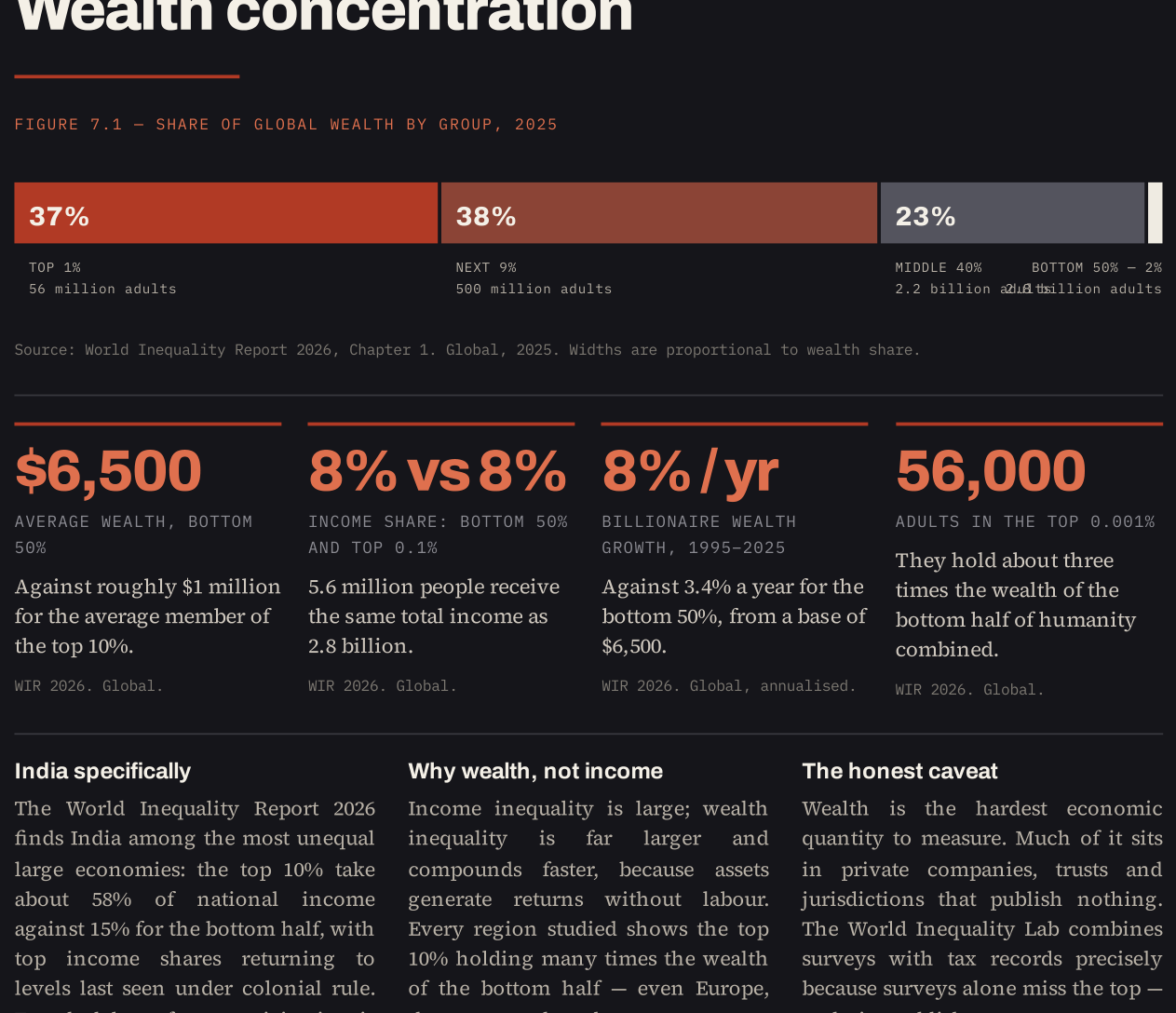
37% 38% 23%
TOP 1% NEXT 9% MIDDLE 40% BOTTOM 50% — 2% 56 million adults 500 million adults 2.2 billion adults2.8 billion adults
Source: World Inequality Report 2026, Chapter 1. Global, 2025. Widths are proportional to wealth share.
$6,500 8% vs 8% 8% / yr 56,000 AVERAGE WEALTH, BOTTOM INCOME SHARE: BOTTOM 50% BILLIONAIRE WEALTH ADULTS IN THE TOP 0.001% 50% AND TOP 0.1% GROWTH, 1995–2025 They hold about three Against roughly $1 million 5.6 million people receive Against 3.4% a year for the times the wealth of the for the average member of the same total income as bottom 50%, from a base of bottom half of humanity the top 10%. 2.8 billion. $6,500. combined.
WIR 2026. Global. WIR 2026. Global. WIR 2026. Global, annualised. WIR 2026. Global.
India specifically Why wealth, not income The honest caveat
The World Inequality Report 2026 Income inequality is large; wealth Wealth is the hardest economic finds India among the most unequal inequality is far larger and quantity to measure. Much of it sits large economies: the top 10% take compounds faster, because assets in private companies, trusts and about 58% of national income generate returns without labour. jurisdictions that publish nothing. against 15% for the bottom half, with Every region studied shows the top The World Inequality Lab combines top income shares returning to 10% holding many times the wealth surveys with tax records precisely levels last seen under colonial rule. of the bottom half — even Europe, because surveys alone miss the top —
Female labour force participation is the most equal, at close to 200 to 1. and it publishes a transparency recorded at 15.7%. index showing no country yet scores full marks.
DIAGRAM 6
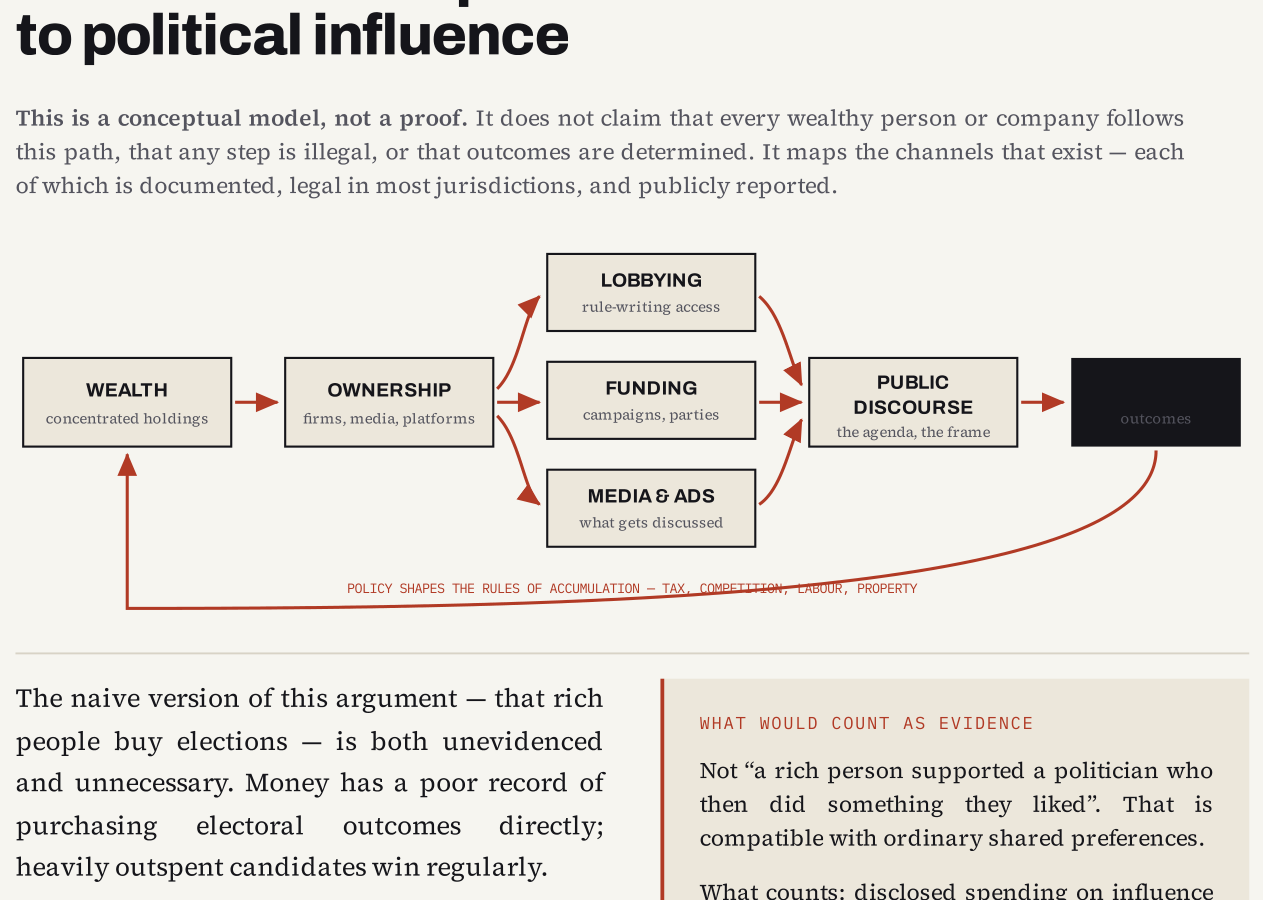
From economic power to political influence
This is a conceptual model, not a proof. It does not claim that every wealthy person or company follows this path, that any step is illegal, or that outcomes are determined. It maps the channels that exist — each of which is documented, legal in most jurisdictions, and publicly reported.
                                          LOBBYING

                                                                        rule-writing access


 WEALTH            OWNERSHIP            FUNDING               PUBLIC              POLICY
                                                           DISCOURSE
concentrated holdings             firms, media, platforms             campaigns, parties                                             outcomes
                                                                                                       the agenda, the frame


                                        MEDIA & ADS

                                                           what gets discussed


                                        POLICY SHAPES THE RULES OF ACCUMULATION — TAX, COMPETITION, LABOUR, PROPERTY
The naive version of this argument — that rich WHAT WOULD COUNT AS EVIDENCE people buy elections — is both unevidenced Not “a rich person supported a politician who and unnecessary. Money has a poor record of then did something they liked”. That is purchasing electoral outcomes directly; compatible with ordinary shared preferences. heavily outspent candidates win regularly. What counts: disclosed spending on influence The better-supported claim concerns what at scale; measurable access differentials; policy outcomes that diverge persistently from happens between elections, where attention is majority opinion in a consistent direction; and low and technical detail is high. A tax documented temporal links between provision, a licensing rule, a safety standard, a payments and decisions.
spectrum allocation. These are decided by The next page presents the first and fourth of small numbers of people, are rarely covered by these, from official disclosure records in two news media, and are enormously valuable to democracies.
concentrated interests while costing each
citizen very little.
That asymmetry is the whole mechanism. The
side with a large, concentrated stake will
always be better organised than the side with a
small, diffuse one — regardless of which is
larger in total.
PART VII — POWER
Two democracies, two disclosure records
Everything on this page is drawn from official filings or court-ordered disclosure. None of it alleges illegality. It is presented because the scale of legal, disclosed influence spending is itself the finding.
United States India
$5.08bn ₹12,979 cr FEDERAL LOBBYING SPENDING, 2025 ELECTORAL BONDS SOLD BEFORE THE SCHEME WAS STRUCK DOWN The first year above $5 billion, up 14% on 2024 and the largest single-year jump since quarterly disclosure In February 2024 the Supreme Court held the began in 2008. 15,768 organisations reported lobbying anonymous electoral bond scheme unconstitutional, activity, up from 14,061. finding it violated voters’ right to information and that unlimited anonymous corporate donations wereOpenSecrets analysis of federal lobbying filings, January 2026. US. manifestly arbitrary. Disclosed data showed roughly 57% went to the governing party.
The trend matters more than the total. Lobbying Supreme Court of India judgment, Feb 2024; SBI data disclosed disclosure captures only registered activity on federal under court order. legislation; it excludes state-level work, litigation
strategy, regulatory comment and the revolving door between agencies and the firms they supervise. ₹3,811 cr It is also worth noting who spends: trade associations, CORPORATE DONATIONS VIA ELECTORAL TRUSTS, 2024–25 unions, universities and advocacy groups appear Roughly triple the ₹1,218 crore of the previous year, as alongside corporations. Lobbying is not exclusively a funding moved into the surviving channel after bonds tool of capital, though capital can afford more of it. were struck down. About 82% went to the BJP.
                                                                Contribution reports filed with the Election Commission of
                                                                India, via Indian Express, Dec 2025.
What this shows What it does not show The counter‑argument
That large sums are legally spent on That any particular policy was Petitioning government is a influencing policy, that the sums are bought. Correlation between democratic right, and organised
rising, and that when one channel donation and outcome is not proof interests include the ones you closes another absorbs the flow. The of exchange, and any document support. Disclosure regimes exist and Indian sequence is unusually clean claiming otherwise from this data is work — every figure here comes evidence of the last point. overreaching. The mechanism is from one. A system in which access and agenda-setting, which is influence is visible is meaningfully
                                harder    to   photograph    than    better than one in which it is not.
                                   corruption.
PART VIII — THE BALANCE SHEET
What capitalism gets remarkably right
This page is not an act of balance. It is the part of the evidence that any serious critique has to survive, and most do not.
- It ended mass subsistence poverty for most of humanity THE NUMBER TO SIT WITH
People in extreme poverty fell from about 2.3 billion in Average income per person rose roughly 1990 to 831 million in 2025, while the world population sixteenfold between 1800 and 2025, while grew by more than two and a half billion. Nothing else population grew eightfold. Life expectancy in recorded history has done this. The largest reductions roughly doubled. Child mortality fell by more came from countries that opened to markets and trade. than ninety per cent. 2. It solves coordination without a coordinator These are not small mercies to be No committee decides how much wheat, steel or acknowledged before returning to the critique. paracetamol a country needs. Prices carry information They are the strongest empirical case any that could not be assembled centrally, and errors are economic system has ever assembled, and any corrected in seasons rather than decades. Every attempt argument that treats them as incidental is not to replace this mechanism wholesale has produced serious. shortage.
- It funds risk that no one can justify in advance
Most innovation fails. A system that spreads bets across THE QUALIFICATIONS, STATED HONESTLYthousands of ventures, tolerates most of them failing and lets the rare success pay for the rest has produced Attribution is hard. Public health, sanitation, more technological change in two centuries than the vaccination and state schooling did much of prior twenty. the work on mortality, and none of those is a market product. 4. It is indifferent to who you are
A market does not check caste, religion or ancestry The gains were uneven. The global middle before accepting payment. This indifference is shallow 40% saw the slowest income growth of any and often overstated, but it has been a real solvent of group since 1980 — slower than both the inherited hierarchy — frequently more effective than bottom half and the top. the laws written against the same hierarchies. Definitions move. Raising the poverty line from $2.15 to $3.00 in June 2025 added 125 million people to the count overnight. The trend is robust; the precision is not.
                                            The bill is partly unpaid. Some of the growth
                                            was financed by drawing on a natural account
                                                          that was never priced.
PART VIII — THE BALANCE SHEET
What it systematically struggles with
Not failures of execution that better management would fix. Structural properties that follow from the mechanism itself.
Anything unpriced The very long term Concentration
Carbon, attention, silence, Discounting makes distant Returns to scale, network effects and biodiversity, social trust. Not consequences shrink toward zero in returns on capital above growth all undervalued — invisible. The present-value terms. A cost arriving push toward accumulation.
instrument has no reading for them. in eighty years is, financially, almost Competition is the remedy and also no cost at all. the thing competition tends to eliminate.
Positional goods Inelastic need Distribution
Where value depends on others Where the buyer cannot decline, the A market clears. It has no view on lacking the thing, more production normal discipline of exit disappears, whether the result is liveable. That cannot satisfy demand. Housing, and price stops carrying judgement has to come from
education and status all behave this information about value. somewhere else, or it does not get way. made.
Is it capable of reform?
The historical record says yes, repeatedly, and further than most critics expected. Child labour, the eight-hour WHAT THE ALTERNATIVES ACTUALLY PROPOSE day, food safety, universal schooling, deposit insurance, Social democracy. Keep markets, tax the clean-air legislation, antitrust and the welfare state were output heavily, decommodify health, each predicted to be incompatible with a functioning education and old age. Well tested; its market economy. Each was absorbed. Market economies constraint is political sustainability, not with very large states now outperform on most economics. measures of human welfare.
Predistribution. Change who owns capitalReform has consistently come from outside the rather than taxing after the fact — worker mechanism — from unions, courts, movements, ownership, sovereign wealth funds, broad- regulators and voters — because the mechanism itself based equity. Less tested at scale.generates no signal that it is doing damage. This suggests the important question is not whether Degrowth. Reject growth as the objective. capitalism can be reformed, but whether the Intellectually coherent about ecological limits; countervailing institutions are currently strong enough has no credible answer for poor countries that to do the reforming. need growth.
On that, the evidence in Part VI and VII is not Central planning. Tried extensively in the encouraging: a falling labour share, declining union twentieth century. The informational problemdensity in most rich countries, and record disclosed spending on political influence all describe a Hayek identified proved real, and the human weakening of exactly those institutions. cost was catastrophic.
                                                Only the first has a long record of working.
                                                 That  is worth knowing before adopting a
                                                            position.
PART VIII — THE BALANCE SHEET
The invisible architecture
Nine ordinary questions, and the economic incentive behind each. None of these answers is the whole story. Each is the part of the story that is usually left out.
“Why did I buy this phone?” “Why do I feel behind?” “Why do I keep scrolling?”
Because durability is a cost and Because your reference group is no Because the decision to stop has replacement is revenue, and because longer your neighbours but the top been removed from the interface,
the working version was made to of every distribution at once, supply is infinite, and reward arrives feel dated. p.13 selected by a system that learned unpredictably. p.22 which comparisons hold you longest. p.25
“Why does every app want “Why do products become “Why do I work more but feel my attention?” obsolete so fast?” insecure?”
Because attention is the raw material Because a firm selling something Because labour’s share of income has
from which behavioural predictions that lasts thirty years eventually fallen while the three costs you are refined, and predictions are what runs out of customers, and one cannot decline — housing, health, actually get sold. p.19 selling something that lasts three education — rose faster than wages. does not. p.13 pp.26, 29
“Why does entertainment “Why are brands part of who I “Why does politics feel like feel identical?” am?” fandom?”
Because commercial risk Because when inherited identity Because it runs on the same management converges on proven weakens, the market has a structural infrastructure, rewards the same formulas, and the feedback loop that advantage in supplying its intensity, and triggers the same enforces this now closes in replacement — fast, legible, identity-fusion response to criticism. milliseconds. pp.15, 18 purchasable today. p.23 p.24
None of these answers implicates a villain. Every one of them describes an incentive that would produce the same outcome no matter who was in charge.
CONCLUSION
Can we live inside the system without being made by it?
The honest answer is: partly, and not by THE UNCOMFORTABLE QUESTIONS trying harder as an individual. Almost If a system shapes not only what we buy but nothing in this document is a problem a what we desire, how much of your person can consume their way out of, individuality is authored by you? because almost nothing in it was caused by If your attention is economically valuable, individual choices. who benefits from your remaining distracted — and would you be able to tell? What changes is the quality of your attention to If culture is a commodity, what happens to the it. A person who can see that a feed has no culture that has no profitable market? Who is ending, that a want was supplied rather than making it, and how are they eating? found, that a metric has quietly replaced a If political influence follows economic power, goal, is not free of the system. But they are what is left of the principle that each citizen making a different kind of decision from counts once? someone who cannot. And if the system that lifted a billion and a half people out of extreme poverty is the sameThe aim of this investigation was never to one concentrating 37% of world wealth in 1% produce anger. Anger is the least useful of adults — can its productive capacity be response available, partly because it is itself an preserved without accepting everything else engagement metric — the machinery described that comes with it?
in Part IV is happy to receive it and will supply
more of whatever provoked it.
WHAT THIS DOCUMENT DELIBERATELY DOES NOTWhat is more useful is a habit: when something DO in ordinary life feels inexplicable, ask what It does not tell you what to conclude, which would have to be true about someone’s revenue party to support, or what to stop buying. That for it to make sense. The answer is available restraint is not neutrality. It is the recognition that a reader who can see the mechanism will surprisingly often, and it is rarely a conspiracy. reach better conclusions than one who has It is usually just an incentive doing exactly been handed them. what incentives do. The goal was the first thing, not the second: to Capitalism has produced more material leave you more able to see the system around you — not simply angrier at it. abundance than any system in history, and it
has done so while creating new forms of
dependence that its own instruments cannot
detect. Both halves of that sentence are true.
The difficulty is that we have no vocabulary
that holds them together, and so most people
are offered a choice between two halves of the
truth.
SOURCES & METHOD
References
Every empirical claim in this document is traceable to a source below. Figures are given with year and geographic scope in the text. Where forecasters or methodologies disagree, the disagreement is shown rather than resolved.
Inequality, income and wealth Advertising, attention and media
[1] Chancel, L., Gómez-Carrera, R., Moshrif, R. & Piketty, T. [10] WARC Media, global ad spend forecast, December 2025; (eds), World Inequality Report 2026, World Inequality Lab, dentsu, Global Ad Spend Forecasts, December 2025; WPP December 2025. wir2026.wid.world Media and Magna Global 2026 forecasts, via INMA.
[2] World Bank, Poverty and Inequality Platform; Poverty and [11] DataReportal / GWI, Digital 2026 Global Overview Report. Inequality Update, Fall 2025; June 2025 Update to Global [12] Comscore box-office data via CNBC, January 2026; Poverty Lines. IndieWire box-office analysis, August 2026; The [3] Our World in Data, “$3 a day: a new poverty line has Numbers, source-material market share, 1995–2025. shifted the World Bank’s data on extreme poverty”, 2025. Environment Labour, wages and productivity [13] ITU & UNITAR, The Global E-waste Monitor 2024; Global E- [4] Economic Policy Institute, The Productivity–Pay Gap and waste Monitor 2020. wage calculator series, United States, 1979–2025. Politics and influence [5] International Labour Organization, World Employment and Social Outlook, September 2024 and May 2025 updates; [14] OpenSecrets, federal lobbying analyses, January 2026 Global Wage Report 2024–25. and April 2026.
[6] Counter-position on deflator methodology: Investigative [15] Supreme Court of India, judgment on the Electoral Bond Economics, “EPI’s misleading pay-productivity gap”, Scheme, February 2024; State Bank of India data 2024. disclosed under court order.
[7] NITI Aayog, India’s Booming Gig and Platform Economy, 2022. [16] Election Commission of India, electoral trust contribution reports 2024–25, reported by The Indian Debt and households Express, December 2025.
[8] Federal Reserve Bank of New York, Quarterly Report on Theory and interpretation Household Debt and Credit, Q1 and Q2 2026. [17] Horkheimer, M. & Adorno, T. W., Dialectic of Enlightenment: [9] Reserve Bank of India, Financial Stability Report, December Philosophical Fragments. Circulated 1944; published 2025 and June 2026; Annual Report 2024–25; Handbook of Amsterdam, Querido, 1947. English edition: ed. G. Statistics on the Indian Economy 2025. Schmid Noerr, trans. E. Jephcott, Stanford University Press, 2002 — chapter “The Culture Industry: Enlightenment as Mass Deception”.
                                                                [18] Adorno, T. W., “On Popular Music”, Studies in Philosophy
                                                         and Social Science, 1941 — origin of standardisation and
                                                                         pseudo-individualisation.

                                                                [19] Horton, D. & Wohl, R. R., “Mass Communication and Para-
                                                                   Social Interaction”, Psychiatry, 1956.

                                                                [20] Veblen, T., The Theory of the Leisure Class, 1899. Keynes, J.
                                                                M., “Economic Possibilities for our Grandchildren”, 1930.
                                                          Hayek, F. A., “The Use of Knowledge in Society”, 1945.
                                                                 Polanyi, K., The Great Transformation, 1944. Zuboff, S., The
                                                             Age of Surveillance Capitalism, 2019.
On the separation of claim types. Measured evidence appears in callouts and figures with source, year and scope. Interpretation appears in body text and is identifiable by its conditional phrasing. Philosophical argument is
attributed to named thinkers. Where a claim could not be sourced to a primary dataset, it was cut rather than softened.
CAPITALISM AND THE COMMON HUMAN 37